Deprecated: Using null as an array offset is deprecated, use an empty string instead in /var/wp2-finnsokung/wordpress/wp-includes/class-wp-block-type-registry.php on line 168
Deprecated: Using null as an array offset is deprecated, use an empty string instead in /var/wp2-finnsokung/wordpress/wp-includes/class-wp-block-type-registry.php on line 168
Deprecated: Using null as an array offset is deprecated, use an empty string instead in /var/wp2-finnsokung/wordpress/wp-includes/class-wp-block-type-registry.php on line 168
Deprecated: Using null as an array offset is deprecated, use an empty string instead in /var/wp2-finnsokung/wordpress/wp-includes/class-wp-block.php on line 257
Deprecated: Using null as an array offset is deprecated, use an empty string instead in /var/wp2-finnsokung/wordpress/wp-includes/class-wp-block-type-registry.php on line 168
Deprecated: Using null as an array offset is deprecated, use an empty string instead in /var/wp2-finnsokung/wordpress/wp-includes/class-wp-block-type-registry.php on line 168
Deprecated: Using null as an array offset is deprecated, use an empty string instead in /var/wp2-finnsokung/wordpress/wp-includes/class-wp-block-type-registry.php on line 168
Deprecated: Using null as an array offset is deprecated, use an empty string instead in /var/wp2-finnsokung/wordpress/wp-includes/class-wp-block-type-registry.php on line 168
Deprecated: Using null as an array offset is deprecated, use an empty string instead in /var/wp2-finnsokung/wordpress/wp-includes/class-wp-block-type-registry.php on line 168
Deprecated: Using null as an array offset is deprecated, use an empty string instead in /var/wp2-finnsokung/wordpress/wp-includes/class-wp-block-type-registry.php on line 168
Deprecated: Using null as an array offset is deprecated, use an empty string instead in /var/wp2-finnsokung/wordpress/wp-includes/class-wp-block-type-registry.php on line 168
Deprecated: Using null as an array offset is deprecated, use an empty string instead in /var/wp2-finnsokung/wordpress/wp-includes/class-wp-block-type-registry.php on line 168
Deprecated: Using null as an array offset is deprecated, use an empty string instead in /var/wp2-finnsokung/wordpress/wp-includes/class-wp-block-type-registry.php on line 168
Deprecated: Using null as an array offset is deprecated, use an empty string instead in /var/wp2-finnsokung/wordpress/wp-includes/class-wp-block.php on line 257
Deprecated: Using null as an array offset is deprecated, use an empty string instead in /var/wp2-finnsokung/wordpress/wp-includes/class-wp-block-type-registry.php on line 168
Deprecated: Using null as an array offset is deprecated, use an empty string instead in /var/wp2-finnsokung/wordpress/wp-includes/class-wp-block-type-registry.php on line 168
Deprecated: Using null as an array offset is deprecated, use an empty string instead in /var/wp2-finnsokung/wordpress/wp-includes/class-wp-block-type-registry.php on line 168
Deprecated: Using null as an array offset is deprecated, use an empty string instead in /var/wp2-finnsokung/wordpress/wp-includes/class-wp-block-type-registry.php on line 168
Deprecated: Using null as an array offset is deprecated, use an empty string instead in /var/wp2-finnsokung/wordpress/wp-includes/class-wp-block-type-registry.php on line 168
When work life changes, we try to change with it. People often can adapt but in the past years there has been an increase in “chronic workplace stress that has not been successfully managed.” One result almost everyone has heard about is Burnout, which received its own ICD code in...
The post Leave Boreout behind – Step by step appeared first on 2 Kind Minds.
]]>Deprecated: Using null as an array offset is deprecated, use an empty string instead in /var/wp2-finnsokung/wordpress/wp-includes/class-wp-block-type-registry.php on line 168
Deprecated: Using null as an array offset is deprecated, use an empty string instead in /var/wp2-finnsokung/wordpress/wp-includes/class-wp-block-type-registry.php on line 168
Deprecated: Using null as an array offset is deprecated, use an empty string instead in /var/wp2-finnsokung/wordpress/wp-includes/class-wp-block-type-registry.php on line 168
Deprecated: Using null as an array offset is deprecated, use an empty string instead in /var/wp2-finnsokung/wordpress/wp-includes/class-wp-block-type-registry.php on line 168
Deprecated: Using null as an array offset is deprecated, use an empty string instead in /var/wp2-finnsokung/wordpress/wp-includes/class-wp-block.php on line 257
Deprecated: Using null as an array offset is deprecated, use an empty string instead in /var/wp2-finnsokung/wordpress/wp-includes/class-wp-block-type-registry.php on line 168
Deprecated: Using null as an array offset is deprecated, use an empty string instead in /var/wp2-finnsokung/wordpress/wp-includes/class-wp-block-type-registry.php on line 168
Deprecated: Using null as an array offset is deprecated, use an empty string instead in /var/wp2-finnsokung/wordpress/wp-includes/class-wp-block-type-registry.php on line 168
Deprecated: Using null as an array offset is deprecated, use an empty string instead in /var/wp2-finnsokung/wordpress/wp-includes/class-wp-block-type-registry.php on line 168
Deprecated: Using null as an array offset is deprecated, use an empty string instead in /var/wp2-finnsokung/wordpress/wp-includes/class-wp-block-type-registry.php on line 168
Deprecated: Using null as an array offset is deprecated, use an empty string instead in /var/wp2-finnsokung/wordpress/wp-includes/class-wp-block-type-registry.php on line 168
Deprecated: Using null as an array offset is deprecated, use an empty string instead in /var/wp2-finnsokung/wordpress/wp-includes/class-wp-block-type-registry.php on line 168
Deprecated: Using null as an array offset is deprecated, use an empty string instead in /var/wp2-finnsokung/wordpress/wp-includes/class-wp-block-type-registry.php on line 168
Deprecated: Using null as an array offset is deprecated, use an empty string instead in /var/wp2-finnsokung/wordpress/wp-includes/class-wp-block-type-registry.php on line 168
Deprecated: Using null as an array offset is deprecated, use an empty string instead in /var/wp2-finnsokung/wordpress/wp-includes/class-wp-block.php on line 257
Deprecated: Using null as an array offset is deprecated, use an empty string instead in /var/wp2-finnsokung/wordpress/wp-includes/class-wp-block-type-registry.php on line 168
Deprecated: Using null as an array offset is deprecated, use an empty string instead in /var/wp2-finnsokung/wordpress/wp-includes/class-wp-block-type-registry.php on line 168
Deprecated: Using null as an array offset is deprecated, use an empty string instead in /var/wp2-finnsokung/wordpress/wp-includes/class-wp-block-type-registry.php on line 168
Deprecated: Using null as an array offset is deprecated, use an empty string instead in /var/wp2-finnsokung/wordpress/wp-includes/class-wp-block-type-registry.php on line 168
Deprecated: Using null as an array offset is deprecated, use an empty string instead in /var/wp2-finnsokung/wordpress/wp-includes/class-wp-block-type-registry.php on line 168
Symptoms of Boreout
People, who suffer from this condition, often feel upset with their low impact at work and at the same time do not have the energy to change something about it or involve anyone. The fear of being exposed as a free-rider, a lazybones or an opportunist causes many people to suffer in silence. They feel exhausted spending most of their time checking in on slack, answering emails or sitting in meetings while feeling unproductive, unhappy and guilty. This problem has increased during the past year.
Pandemic increases the risk
At the beginning of the pandemic people felt isolated in their newly set up home offices. In order to change that they participated in as many meetings as possible. Realizing that this causes them to be even more unproductive they started to reorganize their work successfully. Having more time for new tasks led to either having too much work or because of the economical problems related to the pandemic too little work. Many companies were forced to delay projects or reduce working hours, which gave them even more time than expected. Ending up in a situation like that, might sound appealing for some but is in fact often an unexpected and frustrating result for highly motivated people. It can become a vicious circle. Following Parkinson’s law, which states that “work expands so as to fill the time available for its completion” (C. N. Parkinson 1955 in Economist), people start being overcritical with their work, doubting their performance, which has a negative influence on their self-image.
Where your company starts?
Open communication, regular constructive feedback and transparency in task distribution are only some approaches, which can be helpful to prevent Boreout. However, these need to be initiated and overseen by the leading managers.
Where do you start?
Ask yourself, what can you do, when you :
- Feel that you are missing out on challenges?
- Are feeling unmotivated due to monotonous work or routines?
- Feel burnt out and exhausted just thinking about asking for more work?
Starting at square one by reading this article we will offer you a simple step by step approach, which might help you to start over again.
Step 1: How to recharge your batteries
Boreout and Burnout are both psychological syndromes caused by intense or enduring emotional or work-related stress. Regular self-care and healthy routines have a positive impact on the recovery process. Think about the last time you have been doing something for yourself, which made you feel happy, accepted, fulfilled, appreciated, calm, relaxed or energetic?
If you have problems recalling an event like that or if your memory comes up exclusively with events before the pandemic, there is a good chance that you have been missing out on creating healthy alternatives for yourself. Maybe you were hoping that you could just “go back to normal” once the pandemic has passed. I think it is fair to assume that there will be some problems with that one way or the other. That leaves us with the option to start with something healthy right away. When you think about your earlier life, what were the combining elements of your strategy? Maybe you have been meeting friends, singing in a choir or were a member of a local gym. All these are ways of individual relaxation, which can be effective as long as they are available. Then there is active relaxation, which includes little exercises which regulate your stress level immediately and are available to you at any time.
A short relaxation exercise
Breathing deeply and consciously while counting slowly up. You inhale and count along in your own rhythm up from one until you feel that you cannot inhale any longer. That can be anything up to five to seven or even ten. When you start exhaling you restart counting from one up to a number which is a little higher than during the inhale. This way you make sure your exhalation is a little longer than your inhalation, which will calm you down and keep your mind focused. You can repeat this as often as you feel like it or until you feel calm. For a more intense effect you can try this while being in nature, next to an open window or anywhere with fresh air. For more tools and relaxation exercises visit our webinar or contact us.
Step 2: How to meet the real you
Start with yourself, self-reflection, honesty towards yourself and a good portion of self-compassion. You are a highly skilled and trained employee, you deserve a job in which you can grow and thrive!
What was it, what attracted you to this position in the first place? Maybe your role has shifted or your responsibilities have changed. Maybe you are new to the place and did not yet find your niche. Make sure you bring everything to the table: your values, strengths, interests, skills and your future goals. Take your time and allow yourself a fresh perspective. Is there a difference between you as a private person and you as a professional? Think about yourself as a masterpiece made of many single puzzle pieces. You might not be aware of all there are. In order to change that, request constructive feedback from people you trust, who are supportive and who know you well. Once you feel you have a more realistic view, you might start to have a new lead. Follow this up by asking your social and professional network for support. This can be by endorsements or sharing connections. You are totally worth the time to get to know yourself better!
Step 3: How to make your time count
There are no wrong answers! What are the challenges you are interested in to meet? What are the skills you want to learn? Are you questioning your choices all together?
Complete Change
Maybe this job is not what you hoped for. Maybe you always wanted to become something else all together. There is no better time than now to become serious about it. Consider your options and start living a life that makes you feel happy and fulfilled.
Change of Scenery
Maybe the company you are working for has promised opportunities but now runs short on keeping them. Perhaps the values of the team are not matching your own or the communication is not sufficient. Maybe there is no support for a healthy lifestyle, a growth mindset or equality.
Change of Perspective
Maybe you have been in that role far too long. You see others come and go but you would like to change as well. Maybe you are taken for granted or your company has changed so rapidly that you feel overwhelmed by the increase in tasks you do not enjoy and the lack of career options in your area.
If one or more of these apply, then it is time for a change. Start by making your manager aware of the situation that you would love to try something new. Consider starting by learning something new with the company supporting you. Another option could be switching temporarily to a different position or requesting a mentor for a new field. Contact HR to check for open positions within the company.
If you feel that leaving is the only option, please consider your chances before you go. Make sure you leave prepared with an updated professional network and CV as well as references from your professional network (e.g.: from LinkedIn).
Would you like to have support during your transition period? Feel free to contact us for private counseling sessions. For more tools fighting Boreout check out our 30 Minutes Webinar in June.
References:
Books: Philippe Rothlin, Peter R. Werder: Diagnose Boreout, warum Unterforderung im Job krank macht, Redline, München 2007, ISBN 978-3-636-01462-7. In English: Boreout! Overcoming workplace demotivation. Peter Werder and Philippe Rothlin, (English edition) Kogan Page, October 2008.
Photo: Joonyeop Baek on Unsplash
The post Leave Boreout behind – Step by step appeared first on 2 Kind Minds.
]]>Deprecated: Using null as an array offset is deprecated, use an empty string instead in /var/wp2-finnsokung/wordpress/wp-includes/class-wp-block-type-registry.php on line 168
Deprecated: Using null as an array offset is deprecated, use an empty string instead in /var/wp2-finnsokung/wordpress/wp-includes/class-wp-block-type-registry.php on line 168
Deprecated: Using null as an array offset is deprecated, use an empty string instead in /var/wp2-finnsokung/wordpress/wp-includes/class-wp-block-type-registry.php on line 168
Deprecated: Using null as an array offset is deprecated, use an empty string instead in /var/wp2-finnsokung/wordpress/wp-includes/class-wp-block.php on line 257
Deprecated: Using null as an array offset is deprecated, use an empty string instead in /var/wp2-finnsokung/wordpress/wp-includes/class-wp-block-type-registry.php on line 168
Deprecated: Using null as an array offset is deprecated, use an empty string instead in /var/wp2-finnsokung/wordpress/wp-includes/class-wp-block-type-registry.php on line 168
Deprecated: Using null as an array offset is deprecated, use an empty string instead in /var/wp2-finnsokung/wordpress/wp-includes/class-wp-block-type-registry.php on line 168
Deprecated: Using null as an array offset is deprecated, use an empty string instead in /var/wp2-finnsokung/wordpress/wp-includes/class-wp-block-type-registry.php on line 168
Deprecated: Using null as an array offset is deprecated, use an empty string instead in /var/wp2-finnsokung/wordpress/wp-includes/class-wp-block-type-registry.php on line 168
Deprecated: Using null as an array offset is deprecated, use an empty string instead in /var/wp2-finnsokung/wordpress/wp-includes/class-wp-block-type-registry.php on line 168
Deprecated: Using null as an array offset is deprecated, use an empty string instead in /var/wp2-finnsokung/wordpress/wp-includes/class-wp-block-type-registry.php on line 168
Deprecated: Using null as an array offset is deprecated, use an empty string instead in /var/wp2-finnsokung/wordpress/wp-includes/class-wp-block-type-registry.php on line 168
Deprecated: Using null as an array offset is deprecated, use an empty string instead in /var/wp2-finnsokung/wordpress/wp-includes/class-wp-block-type-registry.php on line 168
Deprecated: Using null as an array offset is deprecated, use an empty string instead in /var/wp2-finnsokung/wordpress/wp-includes/class-wp-block.php on line 257
Deprecated: Using null as an array offset is deprecated, use an empty string instead in /var/wp2-finnsokung/wordpress/wp-includes/class-wp-block-type-registry.php on line 168
Deprecated: Using null as an array offset is deprecated, use an empty string instead in /var/wp2-finnsokung/wordpress/wp-includes/class-wp-block-type-registry.php on line 168
Deprecated: Using null as an array offset is deprecated, use an empty string instead in /var/wp2-finnsokung/wordpress/wp-includes/class-wp-block-type-registry.php on line 168
Deprecated: Using null as an array offset is deprecated, use an empty string instead in /var/wp2-finnsokung/wordpress/wp-includes/class-wp-block-type-registry.php on line 168
Deprecated: Using null as an array offset is deprecated, use an empty string instead in /var/wp2-finnsokung/wordpress/wp-includes/class-wp-block-type-registry.php on line 168
Part II: To-Do Lists Let’s talk about a real hero of getting things done: To-do lists. This small but immensely powerful tool is the make or break of organization and getting things done. To-do lists are used widely and to different degrees of effectiveness. Used correctly they can be a...
The post A Psychologist’s Approach to Time Management appeared first on 2 Kind Minds.
]]>Deprecated: Using null as an array offset is deprecated, use an empty string instead in /var/wp2-finnsokung/wordpress/wp-includes/class-wp-block-type-registry.php on line 168
Deprecated: Using null as an array offset is deprecated, use an empty string instead in /var/wp2-finnsokung/wordpress/wp-includes/class-wp-block-type-registry.php on line 168
Deprecated: Using null as an array offset is deprecated, use an empty string instead in /var/wp2-finnsokung/wordpress/wp-includes/class-wp-block-type-registry.php on line 168
Deprecated: Using null as an array offset is deprecated, use an empty string instead in /var/wp2-finnsokung/wordpress/wp-includes/class-wp-block-type-registry.php on line 168
Deprecated: Using null as an array offset is deprecated, use an empty string instead in /var/wp2-finnsokung/wordpress/wp-includes/class-wp-block.php on line 257
Deprecated: Using null as an array offset is deprecated, use an empty string instead in /var/wp2-finnsokung/wordpress/wp-includes/class-wp-block-type-registry.php on line 168
Deprecated: Using null as an array offset is deprecated, use an empty string instead in /var/wp2-finnsokung/wordpress/wp-includes/class-wp-block-type-registry.php on line 168
Deprecated: Using null as an array offset is deprecated, use an empty string instead in /var/wp2-finnsokung/wordpress/wp-includes/class-wp-block-type-registry.php on line 168
Deprecated: Using null as an array offset is deprecated, use an empty string instead in /var/wp2-finnsokung/wordpress/wp-includes/class-wp-block-type-registry.php on line 168
Deprecated: Using null as an array offset is deprecated, use an empty string instead in /var/wp2-finnsokung/wordpress/wp-includes/class-wp-block-type-registry.php on line 168
Deprecated: Using null as an array offset is deprecated, use an empty string instead in /var/wp2-finnsokung/wordpress/wp-includes/class-wp-block-type-registry.php on line 168
Deprecated: Using null as an array offset is deprecated, use an empty string instead in /var/wp2-finnsokung/wordpress/wp-includes/class-wp-block-type-registry.php on line 168
Deprecated: Using null as an array offset is deprecated, use an empty string instead in /var/wp2-finnsokung/wordpress/wp-includes/class-wp-block-type-registry.php on line 168
Deprecated: Using null as an array offset is deprecated, use an empty string instead in /var/wp2-finnsokung/wordpress/wp-includes/class-wp-block-type-registry.php on line 168
Deprecated: Using null as an array offset is deprecated, use an empty string instead in /var/wp2-finnsokung/wordpress/wp-includes/class-wp-block.php on line 257
Deprecated: Using null as an array offset is deprecated, use an empty string instead in /var/wp2-finnsokung/wordpress/wp-includes/class-wp-block-type-registry.php on line 168
Deprecated: Using null as an array offset is deprecated, use an empty string instead in /var/wp2-finnsokung/wordpress/wp-includes/class-wp-block-type-registry.php on line 168
Deprecated: Using null as an array offset is deprecated, use an empty string instead in /var/wp2-finnsokung/wordpress/wp-includes/class-wp-block-type-registry.php on line 168
Deprecated: Using null as an array offset is deprecated, use an empty string instead in /var/wp2-finnsokung/wordpress/wp-includes/class-wp-block-type-registry.php on line 168
Deprecated: Using null as an array offset is deprecated, use an empty string instead in /var/wp2-finnsokung/wordpress/wp-includes/class-wp-block-type-registry.php on line 168
Let’s talk about a real hero of getting things done: To-do lists. This small but immensely powerful tool is the make or break of organization and getting things done. To-do lists are used widely and to different degrees of effectiveness. Used correctly they can be a tangible and satisfying tool to help you get closer to your goals. So what should you keep in mind when using them?
Common Mistakes of using To-Do Lists
Tasks vs. Goals
One thing that many people get wrong when they start using to-do lists and their everyday life is that they confuse tasks with General goals that they might want to achieve in their life. What I mean by that is that often tasks on to-do lists are not directly actionable. Ideally, every single task on the list is a representation of the “next actionable step” you can directly take in order to get closer to achieving a task or completing a bigger project.
For example, having the vague item “get car checked” on your to-do list can be problematic. It can be difficult to look at this item on the list and understand what you need to do first. Can you do something right now in order for you to get closer to completing this task? A better idea would be to find the next actionable step. In this example this could be “Find number of car garage to make an appointment”. This will make it clear what you can do right now to finally get the car checked.
Multitasking and Decision Fatique
Did you know that in most cases multitasking is not actually possible? Research has shown that so called multitasking is often nothing more than switching rapidly between different tasks. This means, instead of doing two or more tasks at the same time, your attention jumps between tasks. It then, progresses on them a little, before jumping to another task. The problem with this is that task switching drains our energy and on our ability to make decisions. Every time your focus switches from one task to another you need a short moment to understand what you are looking at and what you need to do. Over time this is draining your energy and motivation. It often means that in the end of the day it is harder to make decisions because of decision fatigue.
An easy way for you to decrease the chance of experiencing decision fatigue is by making those tasks on your to-do list very actionable. Another way to prevent decision fatigue is to take time on the previous day to write the list. If that is not possible, write your list in the morning.
This allows you to make decisions on what you are going to do when you are not not already tired. You will notice that it will become easier to make rational decisions on what you can possibly achieve each day.
The length of a To-Do List
An easy way to determine how much is too much for a to-do list is by applying the “1-3-5 rule”. This rule is a handy guide to determine how much a person can usually achieve during a full day. The numbers 1, 3 and 5 each stand for the amount of tasks per category that person can usually complete in a day. 1 stands for the amount of harder or longer tasks that person can complete. A longer or bigger task is usually defined as a task that takes between 3 to 4 hours to complete. What exactly these talks are is up to you. Use your previous experience to determine what a big task is for you. We are all different in the speed and ways we prefer to work. Often a person’s ability varies between days and types of tasks.
The number 3 stands for the amount of medium-sized tasks a daily to-do list should usually include. Medium-sized tasks are usually defined as tasks that can be accomplished in 1 to 2 hours. Again, what kind of tasks can be defined as a medium-sized task for you might vary to another person.
Finally the the number 5 stands for the number of small tasks a person can complete in a day. A small task is usually defined as a task that can be completed in 30 minutes to 1 hour.
Self-Compassion and Productivity
This means that generally about 9 tasks (1+3+5 = 9) can be completed by a person on a daily basis. Of course the amount of work you can complete on one day compared to another can vary widely. It is very important to take into account how you are feeling on that specific day. Also consider what those tasks are, and whether you might have some ad hoc tasks to complete unexpectedly. Try not to make yourself crazy over completing all tasks on your list on a daily basis. If you have a tendency towards perfectionism, you might feel pressure to check off every item. However, consider that you will most likely lose motivation or even develop a burnout if you don’t allow yourself breaks. It is alright if you don’t accomplish everything on your list. Long-term, a self-compassionate approach to productivity will allow you to get more things done.
My Daily To-Do Lists
I want to now talk about the way that I used to do list in my daily life:
At the beginning of this year I started using a technique that you might have heard of before. It is called bullet journaling. Please don’t roll your eyes right now. I am not talking about the visually pleasing but intense technique that you might be envisioning right now. Instead I’m talking about a very simplified version without any calligraphy or drawings. The way I use my bullet journal is very basic.
I only use a cheap journal that I bought in a shop that also sold simple office supplies. It consists of a couple of hundreds of pages. I could explain how I set mine up, but this video by the inventor of the “Bullet Journal Method” explains it much better than I ever could.
How do I do it in Practice?
At the end of each day I sit down and I turn to the next free page in my bullet journal. I copy tasks that I did not complete that day, if they still need to be completed. Then I look at my calendar and check what appointments and tasks I have to do the next day. After I have completed my to-do list, I block out time on my calendar for each item on my list, if they are not on my calendar yet. If I notice that I won’t have time to complete all tasks the next day, I will make adjustments to the list. It is important to me to not overwork myself. It is not my goal to complete all tasks on my to-do list everyday. Instead I aim to complete as many as I can, without feeling extremely fatigued or unmotivated.
Daily- and Ad Hoc Tasks
I have some tasks that I want to complete everyday and I also have them noted on my to-do list. Tasks that I include on my daily to-do list are for example walking my dogs and language training. During meetings I often add tasks to my list. By keeping track of suddenly arising tasks and ideas I end up completing a lot more. I take note of sudden ideas that I might have not been aware of earlier that day. This way I won’t forget them.
Self-Compassion and Productivity
Some days I feel a lot more productive than another day’s. It took me a while to be okay with that. So if you are still struggling with varying levels of productivity on different days I can completely understand your struggles. I used to push myself to complete all my to-do list items each day. After a day of pushing myself too much, I notice that I am too exhausted to accomplish anything for a while. This is a signal to me that I have to take it slower.
I can honestly say that I am much happier now that I use self-compassion as part of my productivity routine. When I started becoming more sustainable with my energy I noticed that I was able to maintain high levels of productivity more easily. I still have days on which I don’t feel capable of completing a lot. On these days I focus on self-care and try not to listen to the voice of my inner critic. I know that allowing myself to rest will ultimately allow me to stay healthy and continue to be productive.
The Inner Critic
I want you to consider whether that voice that might have made itself heard in your head could be that inner critic. Is the voice telling you that you are not as productive as others? Is it giving you the feeling that you are only “good” if you complete all your tasks? This might mean that the voice of your inner critic is still very strong. Don’t worry if it is. Over time you can learn to overwrite that voice and instead treat yourself with self-compassion.
In my experience, you don’t need to worry that eventually you will not be productive at all if you are “too kind” to yourself. Most people who worry that they are not productive enough on a daily basis, are some of the most productive people I meet. I also don’t want you to worry whether you might not be where you are at the moment if it wasn’t for your inner critic. Of course in small increments this voice can help you to keep pushing forward, but if you don’t allow yourself to take breaks or go easy on yourself, eventually you will not be able to be productive at all. Your worth as a person is not determined by how productive you are.
If you need help with challenging your inner critic or with finding a better time management strategy for continuous productivity, do not hesitate to reach out to us. You can book a one-on-one session with either of us or purchase a ticket to one of our upcoming events. For example, we have two brilliant events about time management, one about procrastination and about time management strategies coming up this weekend. I hope that I will see you there.
Reading recommendations:
Getting Things Done: The Art of Stress-Free Productivity by David Allen. David Allen is an Organisation-Guru. He explains all the small and bigger changes to become organized.
The Bullet Journal Method: Track the Past, Order the Present, Design the Future by Ryder Carroll
The inventor of this simple technique explains the ins and outs of how you can use a simple journal to stay on track of your long- and short-term goals.
Photo by Glenn Carstens-Peters on Unsplash
The post A Psychologist’s Approach to Time Management appeared first on 2 Kind Minds.
]]>Deprecated: Using null as an array offset is deprecated, use an empty string instead in /var/wp2-finnsokung/wordpress/wp-includes/class-wp-block-type-registry.php on line 168
Deprecated: Using null as an array offset is deprecated, use an empty string instead in /var/wp2-finnsokung/wordpress/wp-includes/class-wp-block-type-registry.php on line 168
Deprecated: Using null as an array offset is deprecated, use an empty string instead in /var/wp2-finnsokung/wordpress/wp-includes/class-wp-block-type-registry.php on line 168
Deprecated: Using null as an array offset is deprecated, use an empty string instead in /var/wp2-finnsokung/wordpress/wp-includes/class-wp-block.php on line 257
Deprecated: Using null as an array offset is deprecated, use an empty string instead in /var/wp2-finnsokung/wordpress/wp-includes/class-wp-block-type-registry.php on line 168
Deprecated: Using null as an array offset is deprecated, use an empty string instead in /var/wp2-finnsokung/wordpress/wp-includes/class-wp-block-type-registry.php on line 168
Deprecated: Using null as an array offset is deprecated, use an empty string instead in /var/wp2-finnsokung/wordpress/wp-includes/class-wp-block-type-registry.php on line 168
Deprecated: Using null as an array offset is deprecated, use an empty string instead in /var/wp2-finnsokung/wordpress/wp-includes/class-wp-block-type-registry.php on line 168
Deprecated: Using null as an array offset is deprecated, use an empty string instead in /var/wp2-finnsokung/wordpress/wp-includes/class-wp-block-type-registry.php on line 168
Deprecated: Using null as an array offset is deprecated, use an empty string instead in /var/wp2-finnsokung/wordpress/wp-includes/class-wp-block-type-registry.php on line 168
Deprecated: Using null as an array offset is deprecated, use an empty string instead in /var/wp2-finnsokung/wordpress/wp-includes/class-wp-block-type-registry.php on line 168
Deprecated: Using null as an array offset is deprecated, use an empty string instead in /var/wp2-finnsokung/wordpress/wp-includes/class-wp-block-type-registry.php on line 168
Deprecated: Using null as an array offset is deprecated, use an empty string instead in /var/wp2-finnsokung/wordpress/wp-includes/class-wp-block-type-registry.php on line 168
Deprecated: Using null as an array offset is deprecated, use an empty string instead in /var/wp2-finnsokung/wordpress/wp-includes/class-wp-block.php on line 257
Deprecated: Using null as an array offset is deprecated, use an empty string instead in /var/wp2-finnsokung/wordpress/wp-includes/class-wp-block-type-registry.php on line 168
Deprecated: Using null as an array offset is deprecated, use an empty string instead in /var/wp2-finnsokung/wordpress/wp-includes/class-wp-block-type-registry.php on line 168
Deprecated: Using null as an array offset is deprecated, use an empty string instead in /var/wp2-finnsokung/wordpress/wp-includes/class-wp-block-type-registry.php on line 168
Deprecated: Using null as an array offset is deprecated, use an empty string instead in /var/wp2-finnsokung/wordpress/wp-includes/class-wp-block-type-registry.php on line 168
Deprecated: Using null as an array offset is deprecated, use an empty string instead in /var/wp2-finnsokung/wordpress/wp-includes/class-wp-block-type-registry.php on line 168
Becoming and being parents: High expectations and personal growth When we decide to become parents, we might know what we want to incorporate or what we want to distance ourselves from by reflecting on our own childhood. We might start to read about it or exchange thoughts with others about...
The post Sustainable Parenthood: The ABC of Happiness including Acceptance, Boundaries and Cooperation appeared first on 2 Kind Minds.
]]>Deprecated: Using null as an array offset is deprecated, use an empty string instead in /var/wp2-finnsokung/wordpress/wp-includes/class-wp-block-type-registry.php on line 168
Deprecated: Using null as an array offset is deprecated, use an empty string instead in /var/wp2-finnsokung/wordpress/wp-includes/class-wp-block-type-registry.php on line 168
Deprecated: Using null as an array offset is deprecated, use an empty string instead in /var/wp2-finnsokung/wordpress/wp-includes/class-wp-block-type-registry.php on line 168
Deprecated: Using null as an array offset is deprecated, use an empty string instead in /var/wp2-finnsokung/wordpress/wp-includes/class-wp-block-type-registry.php on line 168
Deprecated: Using null as an array offset is deprecated, use an empty string instead in /var/wp2-finnsokung/wordpress/wp-includes/class-wp-block.php on line 257
Deprecated: Using null as an array offset is deprecated, use an empty string instead in /var/wp2-finnsokung/wordpress/wp-includes/class-wp-block-type-registry.php on line 168
Deprecated: Using null as an array offset is deprecated, use an empty string instead in /var/wp2-finnsokung/wordpress/wp-includes/class-wp-block-type-registry.php on line 168
Deprecated: Using null as an array offset is deprecated, use an empty string instead in /var/wp2-finnsokung/wordpress/wp-includes/class-wp-block-type-registry.php on line 168
Deprecated: Using null as an array offset is deprecated, use an empty string instead in /var/wp2-finnsokung/wordpress/wp-includes/class-wp-block-type-registry.php on line 168
Deprecated: Using null as an array offset is deprecated, use an empty string instead in /var/wp2-finnsokung/wordpress/wp-includes/class-wp-block-type-registry.php on line 168
Deprecated: Using null as an array offset is deprecated, use an empty string instead in /var/wp2-finnsokung/wordpress/wp-includes/class-wp-block-type-registry.php on line 168
Deprecated: Using null as an array offset is deprecated, use an empty string instead in /var/wp2-finnsokung/wordpress/wp-includes/class-wp-block-type-registry.php on line 168
Deprecated: Using null as an array offset is deprecated, use an empty string instead in /var/wp2-finnsokung/wordpress/wp-includes/class-wp-block-type-registry.php on line 168
Deprecated: Using null as an array offset is deprecated, use an empty string instead in /var/wp2-finnsokung/wordpress/wp-includes/class-wp-block-type-registry.php on line 168
Deprecated: Using null as an array offset is deprecated, use an empty string instead in /var/wp2-finnsokung/wordpress/wp-includes/class-wp-block.php on line 257
Deprecated: Using null as an array offset is deprecated, use an empty string instead in /var/wp2-finnsokung/wordpress/wp-includes/class-wp-block-type-registry.php on line 168
Deprecated: Using null as an array offset is deprecated, use an empty string instead in /var/wp2-finnsokung/wordpress/wp-includes/class-wp-block-type-registry.php on line 168
Deprecated: Using null as an array offset is deprecated, use an empty string instead in /var/wp2-finnsokung/wordpress/wp-includes/class-wp-block-type-registry.php on line 168
Deprecated: Using null as an array offset is deprecated, use an empty string instead in /var/wp2-finnsokung/wordpress/wp-includes/class-wp-block-type-registry.php on line 168
Deprecated: Using null as an array offset is deprecated, use an empty string instead in /var/wp2-finnsokung/wordpress/wp-includes/class-wp-block-type-registry.php on line 168
When we decide to become parents, we might know what we want to incorporate or what we want to distance ourselves from by reflecting on our own childhood. We might start to read about it or exchange thoughts with others about things we feel uncertain about. This might leave us often feeling overwhelmed by expectations. There is no doubt most parents want the best for their children. The question remains: what is the best? What are the skill important to teach right now? This is especially hard for older parents, who have been experiencing different values in their own childhood.
The Echo of the Past
During my work and because of my interest in the older generation, I learned that the change of the socioeconomic situation towards better usually reflected on our way to deal with our children. In earlier times women had to do most of the childcare alone, they had to do the housework and in some countries they had to work on top of it. In any case they had a lot of responsibilities, which often caused a lot of stress. Mothers always felt torn between work and the wish they had to establish an emotional connection with their child. Let’s acknowledge, how many women still feel that they have to decide between these huge and important tasks? As a result children learned that their own needs and emotions have to stand back behind responsibilities and role expectations. Intrinsic beliefs manifest in many different ways. From fighting change and being extremely inflexible towards other beliefs, to forgetting who we are and what we need to feel happiness. Intrinsic beliefs are at the core of all our decisions. The results have a lasting effect in how we as parents perceive our role until today.
The Chance towards a Brighter Now
Nowadays we have generations of people who suffer from having no conclusive way of connecting emotionally to others nor to themselves. Children often inspire us as grown-ups to change towards better by mirroring our behavior and our beliefs as they are. These situations cause conflicts between the children and their parents but most often within the parents themselves. The result can be anger, desperation and distance. Many parents feel confronted with their need for boundaries and personal growth the first time in their lives. As new parents they suddenly feel vulnerable and judged. This is when they realize the flaws of their own strategie and that is a very sensitive moment to look for guidance.
Staying in Control while offering the Freedom to inspire Growth
Implementing skills like self-love, self-reflection, accepting the emotions of oneself and others into your life, will inspire a growth mindset in your environment. This can result in a change, which is necessary to make it common sense. Let’s be honest, most of us do not know these terms from our childhood experience. We have to learn how to do it first for ourselves and then we can set an example to our children. This leaves many if not most overwhelmed with new expectations.
If it is against what we have experienced, we will struggle automatically with our autopilot steered by personal experience and our rational understanding of how we actually want to do it. This creates a lot of tension and stress. What may help is taking it one step at a time including trial and error, including judgement from other parents and including our own inner critic being unforgiving and demanding. This is exactly where we have to start.
Being a parent is always a work in progress, for our child and most of all for ourselves. We have to be patient with the children and with ourselves. This patience will allow us to create time and opportunity for being accepting of shortcomings. It will help us to be compassionate about making mistakes and motivate us to adjust ourselves. It will help us to create a safe atmosphere to grow and experiment for our children and for ourselves..
Guidance on Self-reflection
Arriving at this blog post might indicate your expectation that valuable information often comes in written form. You are right, the market is flooded with good books. What makes a great book though? Where do we start to look? We usually start with books which are topicwise attuned to our own expectations. This may include a direction we feel comfortable changing to in order to become the parents, we want to be.
This is why I want to share some of the concepts which have been meaningful to me. The books I found them in, left me inspired and evoked self-reflection, which is why I decided to share them with you.
Valuable concepts
Cooperation
“ We cooperate all too often and by doing so lose our integrity.”
This citation comes from a wonderful book written by Jesper Juul. For all who might not know him: He was a famous Danish family therapist. He concluded that we are born cooperating more than we should. According to him there are five parts forming the foundation of a psychological safe environment, which leads to developing a growth mindset. One of the five is Cooperation.
Children tend to cooperate most of the time. This means that they honestly express their needs and as their needs are met, learn to follow the rules of the environment. That means that they accept treatment and information as given facts. What we as parents teach or show them by example, is forming their intrinsic beliefs about themselves and their environment. This forms a dependency which requires cooperation most of the time. They may stop temporarily when they cannot bypass an inner conflict. An inner conflict is often caused by feeling upset, overwhelmed, or frustrated. This usually happens by the pure lack of energy this conflict creates. Once they have rested they will continue to cooperate. However, at an older age they might stop all together, when their integrity is frustrated over a long time and this inner conflict starts to create an unbearable tension.
Grown-ups have the exact same problem. Once they realize that cooperation e.g. in a love relationship, does not automatically lead to getting the personal needs met, they might consider stopping their cooperation. “Acting more self-centred than before” is one way how an often startled partner will know something has changed. Another hint is that they simply start fighting for themselves and their integrity, including individual needs, which can cause bigger conflicts.
As parents we usually cooperate within our close relationships to our partner, our children and other closer relationships. Doing so, we might often forget to make sure that our needs are important as well. When they are not met over a longer period of time, we will feel frustration. This will lead over time to exhaustion, feeling overwhelmed and misunderstood on a regular basis. This situation usually causes additional tension, which can lead to burnout.
Tip 1
Please make sure you, as a parent, take time for yourself including time to reflect on yourself and your well-being, time to express yourself creatively as well as time you spend with your partner alone to reconnect emotionally. Being focused on the needs of others all day can lead to forgetting about who you are, what you need and how you feel.
Check-in on yourself regularly. How do you feel? What do you need? Remember that by communicating your needs clearly and honestly, you increase your chance to be heard. This is true for yourself and this is true for your children as well. Keep in mind that you are the example by which your children will learn how to communicate their needs to their social environment.
Self-esteem
“The way parents treat their children, equals the way they treat themselves.” – Jesper Juul
Self-esteem is according to Jesper Juul another cornerstone of a functioning family life. It means to accept ourselves for who we are. It is different from self-confidence, which reflects within one’s own performance and can be strengthened by mastering skills and learning to use different tools. Self-esteem on the other hand involves an understanding and an acceptance for who we are and what we need. The level of self-esteem predicts how responsible we feel for our own thoughts, feelings and actions. This can be very empowering but it can be painful as well because we often are our worst critics. Successful self-regulation requires a working self-esteem. Without it we are unable to accept our own limitations and will feel guilty and inadequate for most of the time.
Self-esteem is often the problem when there is a lack of drive because many have never learned that it is important to first accept themselves before they find their feeling of deep purpose. This often leads to comparing ourselves with others. This can be helpful for inspiration on what to cook for dinner. However, when we talk about what we need to be happy, it is easy to get side tracked. Feeling lost in the social media storm of what makes others happy, we will find no time to reflect on ourselves. Without meaningful experiences, emotional connection and self-love, all these pictures of others being happy, will create pressure and frustration.
Tip 2
Slow down yourself at least once per day. Give your mind the chance to reduce its pace. This can be as simple as taking a break for breathing calmly, drinking a glass of water slowly or getting aware of your senses by using them. Create stimulating experiences, which help your brain to experience your world in a way that includes all your senses at once. Try to be present once a day to feel what matters in this very moment. This will open your eyes for simple things. Things which are beautiful in the moment. Forgetting about all the “should-haves” and trying to find beauty and gratitude towards yourself.
Boundaries
“You cannot set a boundary you don’t have.” – Shefali Tsabary
This citation comes from the book “the awakened family” and is written by Shefali Tsabary, who is a clinical psychologist and a mindful parent. She writes about how we try to educate our children by setting boundaries, which are none. When our children test them and they do not hold, we tend to get frustrated. This frustration often fires back at them and creates a conflict. Over time this will weaken our position and we will end up in a “power struggle”.
The surprising twist is, that this is not a power struggle at all. Children are not trying to take over. Children ask for good guidance. Having too fluid rules, which only sometimes apply but do fluctuate more often than that they stand cause uncertainty. This threatens the need for safety, which is a basic need. All what children try to do is to ask us to clarify our rules by questioning them.
So far the advice has been that we need to be stricter with the children when we actually need to be stricter with ourselves. By that I mean that we have to be transparent about the “why” and crystal clear about then “when”. This information can be useful when we are asked. What we need it to understand is why we cannot give in, once we decide on it.
We often lack the experience to know how to be a good leader, simply because we have learned to follow all our life. To be confronted with this right now, is okay. This is the chance to learn how to be a good leader, a good parent and how to grow your self-esteem as well.
“If we create clear, consistent, compassionate boundaries for our children, the need for disciplinary strategies is unnecessary.” – Shefali Tsabary
Creating a safe environment with clearly defined rules, encourages everyone to share how they feel because they are being heard and accepted for who they are. This atmosphere of trust, respect and transparency helps everyone in it to grow according to their own abilities.
How do we start that? By using the word “no” more consciously, when we feel that our boundaries are violated. By hearing the word “no” more frequently and accepting when others try to protect their boundaries.
“In a competent family, all are helping each other to say “no”. This strengthens the relationships.” – Jesper Juul
By voicing and accepting a “no”, we show the other person that we are both equal and individual. This all sounds contradictory. However, it is possible. Standing by what we need and who we are, we give the other the chance to understand our motivation. This gives them the opportunity to decide whether they want to cooperate or compromise in the given moment. A discussion is enabled and a solution can be found.
Why is it often so hard? This process is often disturbed by the way we analyse the situation. Some think the other wants to manipulate them, others think about gain and loss, often it is about who is right and wrong. This black and white thinking requires a winner and a loser, which is a very frustrating thought for the weaker side. With children it means that they have often no way of phrasing what they need simply because they do not know how. When a simple “no” is followed by a cascade of criticism which leads to a guilt trip through “Why not, this was expensive, which is why your feelings do not count.”-country, instead of sitting down and trying to establish an understanding of the situation, we have lost already. From my own experience I can say, often the reason behind a “no” is far less selfish than most parents are prepared to hear. Often it is an underlying fear.
This is not much different from grown-ups, who are quite creative to avoid situations, which cause them discomfort. Most of us have had at least once in our life the need to say “no” but said “yes” or “okay” instead. If the result of this was negative, we will carry that guilt for a long time. Not only because we did not have the energy or power to resist but because we felt that we were betraying ourselves by deciding against our personal conviction. Violating boundaries, no matter whether they are our own or the ones of our partner and children, will reduce the trust in ourselves and the relationship with others. This will create frustration as well as anxiety and as a result we might try to avoid conflicts all together. This strategy to create “harmony” will create more inner tension because feelings cannot be exchanged. This is a very problematic strategy because frustration builds up over a long time and can lead to irreconcilable differences between family members.
Tip 3
Try to be open about how you feel towards your loved ones. If you feel this is hard because you feel uncertain how they react, please start with one simple thing. (e.g. I feel tired and I need to rest. I will lay down for a moment. Please do not disturb me for the next 30 minutes. After 30 Minutes I will rejoin and we can play/talk together.) If you feel that this is impossible because there is already toxicity present by open verbal or physical aggression, please get help. Boundaries are important but this only works as a two way street. There is empathy needed from both sides. If we have lost the sense for hearing the fine notes or we have never experienced being attuned to ourselves, then now is the time to start!
Empathy
“We must move beyond judgements of right and wrong. Instead ask what the individuals were experiencing on an internal level. Focusing on how we can deeply align with the “as is” of our own and our children’s feelings.” – Shefali Tsabary
Empathy is the ability to understand the emotions of another person in their context and experience them in the moment they are shared without hesitation. Sharing in this context is free from judgement. The knowledge that an emotion is not good or bad is important for allowing it to be present. In that moment when we allow it to be present in a safe and controlled way, we can confront it and learn to accept it as it is. This is very easy when we talk about joy or excitement, feelings we are used to sharing. It gets harder when we talk about anger or sadness but it starts to be complicated when we talk about fear.
In this moment we allow ourselves to leave our position and follow the other into their world. We see what they see and feel what they feel. We acknowledge all what we experience and connect in doing so deeply with the other person. After we were allowed to share, we can reflect on it and see what it does to us and what our own strategies for this might be. Giving Feedback about how this makes us feel, might help to encourage the other that their feelings have been valid and worth reflecting on.
This is something that can be learned. There are many ways to approach it. The first obstacle is always the will and motivation to accept that our own position is as right as the other one’s and can be at the same time as wrong. Accepting this is very hard.
However, this experience will change your perspective. Maybe not completely but it will enrich your world.
The next obstacle is that feelings negative or positive should never be judged by being right or wrong. Instead we can try to understand their purpose. Accepting fear without avoiding it, by letting it be present, is against all we know. Please understand, I mean the presence of fear not threat. Fear is an emotion which tends to warn us of an approaching threat. There is a difference. Fear is present in our lives every day. We are worried about being bad parents, we are worried about the safety of our loved ones, and we are worried about failing. These are just a couple of clear examples but there are subtle ones like worrying about not living up to expectations, making loved ones unhappy or creating additional tension by asking for something from others.
In short we are often worried to verbalize our needs. We are worried that others will treat us as we treat ourselves by simply ignoring our needs and refusing to cooperate. This is the point where we need to take a deep breath, because yes, this is often the way people treat themselves and this is the way we expect others to treat us in return. When we allow others to choose how they want to react to our needs, by sharing them with them, we will benefit from that. One benefit will be that there is a chance the other loves us and wants to support us. The other benefit will be that by seeing and sharing each other’s needs and emotions we will get a more realistic self-image. Another benefit will be that these experiences help us to establish a deeper emotional bound to others and to ourselves, which increases our self-esteem and thus our well-being.
Tip 4:
Trying to let the inner critic rest for a certain time, will give you a better picture about what you really need. Including a Self-compassion practice in your daily routine will be a time for reflecting positively on experiences. Instead of the usual guilt you can empower yourself and learn from mistakes. This mindshift will create a framework for children and parents to thrive, to connect, to develop self-esteem and resilience. Let’s be kinder to one another and to ourselves.
Resources:
Books:
- Juul, J. (2012) Family Life: The Most Important Values For Living Together and Raising Children. Author house UK.
- Tsabary, S. (2016) The Awakened Family. Penguin Random House USA.
Photo:
The post Sustainable Parenthood: The ABC of Happiness including Acceptance, Boundaries and Cooperation appeared first on 2 Kind Minds.
]]>Deprecated: Using null as an array offset is deprecated, use an empty string instead in /var/wp2-finnsokung/wordpress/wp-includes/class-wp-block-type-registry.php on line 168
Deprecated: Using null as an array offset is deprecated, use an empty string instead in /var/wp2-finnsokung/wordpress/wp-includes/class-wp-block-type-registry.php on line 168
Deprecated: Using null as an array offset is deprecated, use an empty string instead in /var/wp2-finnsokung/wordpress/wp-includes/class-wp-block-type-registry.php on line 168
Deprecated: Using null as an array offset is deprecated, use an empty string instead in /var/wp2-finnsokung/wordpress/wp-includes/class-wp-block.php on line 257
Deprecated: Using null as an array offset is deprecated, use an empty string instead in /var/wp2-finnsokung/wordpress/wp-includes/class-wp-block-type-registry.php on line 168
Deprecated: Using null as an array offset is deprecated, use an empty string instead in /var/wp2-finnsokung/wordpress/wp-includes/class-wp-block-type-registry.php on line 168
Deprecated: Using null as an array offset is deprecated, use an empty string instead in /var/wp2-finnsokung/wordpress/wp-includes/class-wp-block-type-registry.php on line 168
Deprecated: Using null as an array offset is deprecated, use an empty string instead in /var/wp2-finnsokung/wordpress/wp-includes/class-wp-block-type-registry.php on line 168
Deprecated: Using null as an array offset is deprecated, use an empty string instead in /var/wp2-finnsokung/wordpress/wp-includes/class-wp-block-type-registry.php on line 168
Deprecated: Using null as an array offset is deprecated, use an empty string instead in /var/wp2-finnsokung/wordpress/wp-includes/class-wp-block-type-registry.php on line 168
Deprecated: Using null as an array offset is deprecated, use an empty string instead in /var/wp2-finnsokung/wordpress/wp-includes/class-wp-block-type-registry.php on line 168
Deprecated: Using null as an array offset is deprecated, use an empty string instead in /var/wp2-finnsokung/wordpress/wp-includes/class-wp-block-type-registry.php on line 168
Deprecated: Using null as an array offset is deprecated, use an empty string instead in /var/wp2-finnsokung/wordpress/wp-includes/class-wp-block-type-registry.php on line 168
Deprecated: Using null as an array offset is deprecated, use an empty string instead in /var/wp2-finnsokung/wordpress/wp-includes/class-wp-block.php on line 257
Deprecated: Using null as an array offset is deprecated, use an empty string instead in /var/wp2-finnsokung/wordpress/wp-includes/class-wp-block-type-registry.php on line 168
Deprecated: Using null as an array offset is deprecated, use an empty string instead in /var/wp2-finnsokung/wordpress/wp-includes/class-wp-block-type-registry.php on line 168
Deprecated: Using null as an array offset is deprecated, use an empty string instead in /var/wp2-finnsokung/wordpress/wp-includes/class-wp-block-type-registry.php on line 168
Deprecated: Using null as an array offset is deprecated, use an empty string instead in /var/wp2-finnsokung/wordpress/wp-includes/class-wp-block-type-registry.php on line 168
Deprecated: Using null as an array offset is deprecated, use an empty string instead in /var/wp2-finnsokung/wordpress/wp-includes/class-wp-block-type-registry.php on line 168
What are techniques of sustainable parents to include self-care and to maintain their mental and physical well-being? Nobody needs to tell me that parenting is more than a full-time job. While I haven’t got children myself, I have worked with children and for parents in a variety of capacities. I...
The post Sustainable Parenthood: Self-Care for busy Parents appeared first on 2 Kind Minds.
]]>Deprecated: Using null as an array offset is deprecated, use an empty string instead in /var/wp2-finnsokung/wordpress/wp-includes/class-wp-block-type-registry.php on line 168
Deprecated: Using null as an array offset is deprecated, use an empty string instead in /var/wp2-finnsokung/wordpress/wp-includes/class-wp-block-type-registry.php on line 168
Deprecated: Using null as an array offset is deprecated, use an empty string instead in /var/wp2-finnsokung/wordpress/wp-includes/class-wp-block-type-registry.php on line 168
Deprecated: Using null as an array offset is deprecated, use an empty string instead in /var/wp2-finnsokung/wordpress/wp-includes/class-wp-block-type-registry.php on line 168
Deprecated: Using null as an array offset is deprecated, use an empty string instead in /var/wp2-finnsokung/wordpress/wp-includes/class-wp-block.php on line 257
Deprecated: Using null as an array offset is deprecated, use an empty string instead in /var/wp2-finnsokung/wordpress/wp-includes/class-wp-block-type-registry.php on line 168
Deprecated: Using null as an array offset is deprecated, use an empty string instead in /var/wp2-finnsokung/wordpress/wp-includes/class-wp-block-type-registry.php on line 168
Deprecated: Using null as an array offset is deprecated, use an empty string instead in /var/wp2-finnsokung/wordpress/wp-includes/class-wp-block-type-registry.php on line 168
Deprecated: Using null as an array offset is deprecated, use an empty string instead in /var/wp2-finnsokung/wordpress/wp-includes/class-wp-block-type-registry.php on line 168
Deprecated: Using null as an array offset is deprecated, use an empty string instead in /var/wp2-finnsokung/wordpress/wp-includes/class-wp-block-type-registry.php on line 168
Deprecated: Using null as an array offset is deprecated, use an empty string instead in /var/wp2-finnsokung/wordpress/wp-includes/class-wp-block-type-registry.php on line 168
Deprecated: Using null as an array offset is deprecated, use an empty string instead in /var/wp2-finnsokung/wordpress/wp-includes/class-wp-block-type-registry.php on line 168
Deprecated: Using null as an array offset is deprecated, use an empty string instead in /var/wp2-finnsokung/wordpress/wp-includes/class-wp-block-type-registry.php on line 168
Deprecated: Using null as an array offset is deprecated, use an empty string instead in /var/wp2-finnsokung/wordpress/wp-includes/class-wp-block-type-registry.php on line 168
Deprecated: Using null as an array offset is deprecated, use an empty string instead in /var/wp2-finnsokung/wordpress/wp-includes/class-wp-block.php on line 257
Deprecated: Using null as an array offset is deprecated, use an empty string instead in /var/wp2-finnsokung/wordpress/wp-includes/class-wp-block-type-registry.php on line 168
Deprecated: Using null as an array offset is deprecated, use an empty string instead in /var/wp2-finnsokung/wordpress/wp-includes/class-wp-block-type-registry.php on line 168
Deprecated: Using null as an array offset is deprecated, use an empty string instead in /var/wp2-finnsokung/wordpress/wp-includes/class-wp-block-type-registry.php on line 168
Deprecated: Using null as an array offset is deprecated, use an empty string instead in /var/wp2-finnsokung/wordpress/wp-includes/class-wp-block-type-registry.php on line 168
Deprecated: Using null as an array offset is deprecated, use an empty string instead in /var/wp2-finnsokung/wordpress/wp-includes/class-wp-block-type-registry.php on line 168
Nobody needs to tell me that parenting is more than a full-time job. While I haven’t got children myself, I have worked with children and for parents in a variety of capacities. I worked as a babysitter, an au pair, an afternoon instructor at a primary school and have experience working with children of six months to 13 years.
The way in which parents I worked with were able to maintain their own mental and physical well-being varied a lot from person to person. Of course some factors can increase or decrease the challenges parents face in building sustainable self-care routines. The number, activity level and age of children, whether disabilities are present and the supporting network surrounding that parent are factors that influence the difficulty of building sustainable self-care routines, meaning self-care routines that can be maintained for a long time. On the other side stand a variety of techniques that can help with introducing practices of sustainable parents with a calmer mindset towards childcare and an ultimately improved relationship experience for parents and their children alike.
I am sharing some of the techniques sustainable parents used in their daily lives:
1) Really prioritizing me-time.
Please don’t roll your eyes now. Most of us know that taking time for ourselves is essential. However, try to be honest: Do you really prioritize self-care on a regular basis? What does that look like for you?
I noticed that parents who planned their self-care time into their calendars and who communicated clearly in an age-appropriate way with their child beforehand, were able to put their plans into action more successfully. Mostly, unless we plan out our goals clearly and realistically, it is difficult to actually reach them. You could even go as far as to use “SMART” goals in setting your self-care goals.
For example, if you would like to introduce regular “me-time” into your schedule you could first look ahead in your calendar and find a slot for your self-care time. Depending on the fullness of your schedule this might be several weeks or even months ahead. To make this something to look forward to, decide how you would like to spend your time with yourself. Anything that makes you feel good and does not harm you long-term works. This can be anything from taking a long leisurely walk, doing something creative or catching up with friends.
2) Getting the priorities straight.
When becoming parents imagine how their lives will change after having the baby they often visualize a more ideal picture of life with a baby, than what it ultimately will turn out to be. This is completely normal and part of looking forward to becoming a parent. People who are already parents know that life gets chaotic and that the chore list only seems to grow at times. This is a great opportunity to step back and evaluate the tasks on the to-do list. Which of these items are really necessary, and which ones are an additional bonus that I can take care of afterwards?
Depending on how swamped you feel, this might include items such as tidying up or getting things fixed around the house. Bluntly stated, a good rule of thumb is to determine if the health and safety of any members of the household are in danger if the task is not completed. No? Great, this means that this item is non-essential. Taking care of your mental and physical well-being, such as by taking breaks or getting as close as possible to eight hours of sleep are essential.
3) Defending your “me-time” from yourself.
Congratulations, you have completed the essentials of every-day life and your children are appropriately taken care of for a while. What’s next? You might be tempted to tackle the laundry or postpone your scheduled “me-time” for another secondary task on your to-do list, but hear me out first: You worked hard to keep this time for yourself, it would be a shame if you did not take advantage of your hard work now. You would not skip out on a promise you made a friend, would you? So why would you skip out on a promise you made yourself?
Why should you be keeping your promises to yourself? If you ignore your promises to yourself regularly, it will get easier and easier to postpone your allotted “me-time”. Over time, postponing it will become a habit. Think about it this way: By not sticking with them, you are telling yourself “My self-care is not as important as the chores on my to-do list”. Try not to postpone your time for self-care by sticking and using the time for, you guessed it, yourself.
4) Defending your “me-time” from others.
Now you are ready to start diving into the activity you have chosen for yourself. Yay! Suddenly your phone rings and it is an acquaintance who wants to catch up. Maybe they tend to drone on for a while, so you settle in to listen, once again. Stop! You are about to lose your precious time that you worked so hard for.
An option is to calmly, but clearly tell them that you don’t have time at the moment. You can then ask whether you could talk another time. By letting other people know that you take your plans seriously, you are giving them the signal that self-care is a priority for you. Over time the people around you will understand and adjust to this need of yours. Perhaps they might even get inspired to take their own plans for themselves more seriously as well.
5) Distancing yourself from the super-parent attitude
To be a great parent you might want to stop trying to be a perfect parent. Often we apply stricter rules to ourselves than to others. Maybe for you other parents are doing well even when they don’t sew all of their kids’ costumes themselves or are active members in parent groups. Sadly, we often don’t extend this leniency towards ourselves. Standards are great, but try to not put too much pressure on yourself. Parenting is hard enough without having to constantly run extra miles. Focus on the essentials, anything extra is a bonus.
For example, you can learn to distinguish between essential and bonus tasks by asking yourself: “Would I judge a friend for dropping this task?”. If the answer is “no”, it is probably a bonus task and you can decide whether you take it on, or not. It is alright if you chose not to.
6) Sharing child minding tasks equally
Let’s address the elephant in the room: Most of the time child minding is not shared equally between the partners. Statistically, women still carry a much heavier share of the child minding and house work. In my work as a child minder I have only seldom seen these tasks divided up equally. During a time when most women in the western world work jobs themselves, carrying the lion’s share of most care work at the same time is an unfair reality. This reality is holding many women back in their well-being journey and their professional ambitions.
It is possible to create a fairer division of tasks. A good starting point towards sharing tasks equally is to first get a realistic overview on what the tasks are.
Start by writing down each individual task that needs to be done in order for the household to run smoothly. Then the two partners can sit down together and divvy the tasks up in a way that is fair. You can share cooking and grocery buying duties and decide who is responsible for the cooking on what days, while the other is taking care of the other days. The same goes for bringing the children to school, kindergarten or their afternoon activities, cleaning and all other chores.
Be aware that these changes will take time to implement and to run smoothly. Both sides will have to figure the new situation out in their way. If you are the one who took care of most of these tasks by yourself before, you might have to learn to let go and let your partner find their own way to complete these tasks. Open and clear communication is clear. Discuss what “Done” looks like for each task and try to be open to get issues resolved. If both parties are truly invested in striving towards a more equal distribution of tasks, it will get easier over time.
If you feel like you have a lot of work to do in order to prioritize and make use of self-care strategies, you are not alone. In my work I frequently try to help people with a wide variety of backgrounds, parents or not, in establishing more sustainable self-care routines. It is normal to struggle with building habits, and becoming a person who knows how to set and defend their boundaries. If you would like to learn more about this topic, or need some help with establishing new routines you can reach out to us for shorter 30-minute, or longer 1-hour 1-on-1 sessions or join our upcoming webinar on “Sustainable Parenthood”.
Photo by Jazmin Quaynor on Unsplash
The post Sustainable Parenthood: Self-Care for busy Parents appeared first on 2 Kind Minds.
]]>Deprecated: Using null as an array offset is deprecated, use an empty string instead in /var/wp2-finnsokung/wordpress/wp-includes/class-wp-block-type-registry.php on line 168
Deprecated: Using null as an array offset is deprecated, use an empty string instead in /var/wp2-finnsokung/wordpress/wp-includes/class-wp-block-type-registry.php on line 168
Deprecated: Using null as an array offset is deprecated, use an empty string instead in /var/wp2-finnsokung/wordpress/wp-includes/class-wp-block-type-registry.php on line 168
Deprecated: Using null as an array offset is deprecated, use an empty string instead in /var/wp2-finnsokung/wordpress/wp-includes/class-wp-block.php on line 257
Deprecated: Using null as an array offset is deprecated, use an empty string instead in /var/wp2-finnsokung/wordpress/wp-includes/class-wp-block-type-registry.php on line 168
Deprecated: Using null as an array offset is deprecated, use an empty string instead in /var/wp2-finnsokung/wordpress/wp-includes/class-wp-block-type-registry.php on line 168
Deprecated: Using null as an array offset is deprecated, use an empty string instead in /var/wp2-finnsokung/wordpress/wp-includes/class-wp-block-type-registry.php on line 168
Deprecated: Using null as an array offset is deprecated, use an empty string instead in /var/wp2-finnsokung/wordpress/wp-includes/class-wp-block-type-registry.php on line 168
Deprecated: Using null as an array offset is deprecated, use an empty string instead in /var/wp2-finnsokung/wordpress/wp-includes/class-wp-block-type-registry.php on line 168
Deprecated: Using null as an array offset is deprecated, use an empty string instead in /var/wp2-finnsokung/wordpress/wp-includes/class-wp-block-type-registry.php on line 168
Deprecated: Using null as an array offset is deprecated, use an empty string instead in /var/wp2-finnsokung/wordpress/wp-includes/class-wp-block-type-registry.php on line 168
Deprecated: Using null as an array offset is deprecated, use an empty string instead in /var/wp2-finnsokung/wordpress/wp-includes/class-wp-block-type-registry.php on line 168
Deprecated: Using null as an array offset is deprecated, use an empty string instead in /var/wp2-finnsokung/wordpress/wp-includes/class-wp-block-type-registry.php on line 168
Deprecated: Using null as an array offset is deprecated, use an empty string instead in /var/wp2-finnsokung/wordpress/wp-includes/class-wp-block.php on line 257
Deprecated: Using null as an array offset is deprecated, use an empty string instead in /var/wp2-finnsokung/wordpress/wp-includes/class-wp-block-type-registry.php on line 168
Deprecated: Using null as an array offset is deprecated, use an empty string instead in /var/wp2-finnsokung/wordpress/wp-includes/class-wp-block-type-registry.php on line 168
Deprecated: Using null as an array offset is deprecated, use an empty string instead in /var/wp2-finnsokung/wordpress/wp-includes/class-wp-block-type-registry.php on line 168
Deprecated: Using null as an array offset is deprecated, use an empty string instead in /var/wp2-finnsokung/wordpress/wp-includes/class-wp-block-type-registry.php on line 168
Deprecated: Using null as an array offset is deprecated, use an empty string instead in /var/wp2-finnsokung/wordpress/wp-includes/class-wp-block-type-registry.php on line 168
Resilience When we talk about Resilience, we can think of it as the strength to withstand difficult times. We might feel like we need to push ourselves and appear indestructible like a rock in the sea, withstanding all weathers. However, originally the word resilience derives from the Latin word resilire,...
The post How Resilience and Relaxation improve your Quality of Life appeared first on 2 Kind Minds.
]]>Deprecated: Using null as an array offset is deprecated, use an empty string instead in /var/wp2-finnsokung/wordpress/wp-includes/class-wp-block-type-registry.php on line 168
Deprecated: Using null as an array offset is deprecated, use an empty string instead in /var/wp2-finnsokung/wordpress/wp-includes/class-wp-block-type-registry.php on line 168
Deprecated: Using null as an array offset is deprecated, use an empty string instead in /var/wp2-finnsokung/wordpress/wp-includes/class-wp-block-type-registry.php on line 168
Deprecated: Using null as an array offset is deprecated, use an empty string instead in /var/wp2-finnsokung/wordpress/wp-includes/class-wp-block-type-registry.php on line 168
Deprecated: Using null as an array offset is deprecated, use an empty string instead in /var/wp2-finnsokung/wordpress/wp-includes/class-wp-block.php on line 257
Deprecated: Using null as an array offset is deprecated, use an empty string instead in /var/wp2-finnsokung/wordpress/wp-includes/class-wp-block-type-registry.php on line 168
Deprecated: Using null as an array offset is deprecated, use an empty string instead in /var/wp2-finnsokung/wordpress/wp-includes/class-wp-block-type-registry.php on line 168
Deprecated: Using null as an array offset is deprecated, use an empty string instead in /var/wp2-finnsokung/wordpress/wp-includes/class-wp-block-type-registry.php on line 168
Deprecated: Using null as an array offset is deprecated, use an empty string instead in /var/wp2-finnsokung/wordpress/wp-includes/class-wp-block-type-registry.php on line 168
Deprecated: Using null as an array offset is deprecated, use an empty string instead in /var/wp2-finnsokung/wordpress/wp-includes/class-wp-block-type-registry.php on line 168
Deprecated: Using null as an array offset is deprecated, use an empty string instead in /var/wp2-finnsokung/wordpress/wp-includes/class-wp-block-type-registry.php on line 168
Deprecated: Using null as an array offset is deprecated, use an empty string instead in /var/wp2-finnsokung/wordpress/wp-includes/class-wp-block-type-registry.php on line 168
Deprecated: Using null as an array offset is deprecated, use an empty string instead in /var/wp2-finnsokung/wordpress/wp-includes/class-wp-block-type-registry.php on line 168
Deprecated: Using null as an array offset is deprecated, use an empty string instead in /var/wp2-finnsokung/wordpress/wp-includes/class-wp-block-type-registry.php on line 168
Deprecated: Using null as an array offset is deprecated, use an empty string instead in /var/wp2-finnsokung/wordpress/wp-includes/class-wp-block.php on line 257
Deprecated: Using null as an array offset is deprecated, use an empty string instead in /var/wp2-finnsokung/wordpress/wp-includes/class-wp-block-type-registry.php on line 168
Deprecated: Using null as an array offset is deprecated, use an empty string instead in /var/wp2-finnsokung/wordpress/wp-includes/class-wp-block-type-registry.php on line 168
Deprecated: Using null as an array offset is deprecated, use an empty string instead in /var/wp2-finnsokung/wordpress/wp-includes/class-wp-block-type-registry.php on line 168
Deprecated: Using null as an array offset is deprecated, use an empty string instead in /var/wp2-finnsokung/wordpress/wp-includes/class-wp-block-type-registry.php on line 168
Deprecated: Using null as an array offset is deprecated, use an empty string instead in /var/wp2-finnsokung/wordpress/wp-includes/class-wp-block-type-registry.php on line 168
When we talk about Resilience, we can think of it as the strength to withstand difficult times. We might feel like we need to push ourselves and appear indestructible like a rock in the sea, withstanding all weathers. However, originally the word resilience derives from the Latin word resilire, which means “to jump back”. This means it can be rather compared to how plants like grass or bamboo bend during heavy rain, rather than break. This flexibility towards difficult circumstances was first mentioned in a study by Emmy Werner in the year 1955, in which she observed the development of children in Kauai. During this long-term study different circumstances seemed to have a special impact on the course of their personal development. Since then the Dunedin longitudinal study came to the same conclusions:
There are many factors that influence our ability to react to difficult or stressful events. A difficult start in life, impacts our lives from early on and we will have to work harder than others to withstand the same amounts of stress. However, this is not the end of the story.
Nature and Nurture
Resilience depends on many factors, which impact our physical and psychological development. We often think that the nature of our being is something we might not have much of a say over. That our static genes define how we look and to a degree what we do, which includes how we cope with difficulties. But did you know that genes are in fact flexible?
It was shown that genes react and adapt to changes in the environment. This flexibility points out the reciprocal influence of nature and nurture. As a result taking care of ourselves by ensuring a healthy lifestyle can help us to stay healthy and resilient or improve our current state. The level of resilience can be actively improved. This healthy lifestyle is depending on many factors, such as stable routines, which help us to achieve enough sleep, good nutrition, hydration and a good ratio of work and leisure time.
Believe it or not: You are already resilient!
The fact that you made it this far in life and that so far you have made it out of all the difficult situations alive, is a clear sign that you are resilient. Our clients tell us that they feel like they don’t know how to continue on, that they feel overwhelmed with stress, that they have already been living with high levels of stress for such a long time and aren’t aware anymore how it feels like to be balanced.
Most feel overwhelmed with stress, and struggle to see a way out. One of the ways that stress lowers resilience is by making it impossible to think creatively about solutions. When we are experiencing high levels of stress we are often incapable of remembering all the tools we have to help ourselves and all the strategies we could apply, not to mention creative combinations of either.
Stress is natural, which is why our body is adapted to react quickly and regulate the stress level after the danger is over. This resilience mechanism helps us to regulate our quality of life. Unfortunately nowadays stress seems to be omnipresent, which often results in chronically high stress levels. This is often as strenuous as running a marathon every day. The body is not designed for that and the result is extreme exhaustion.
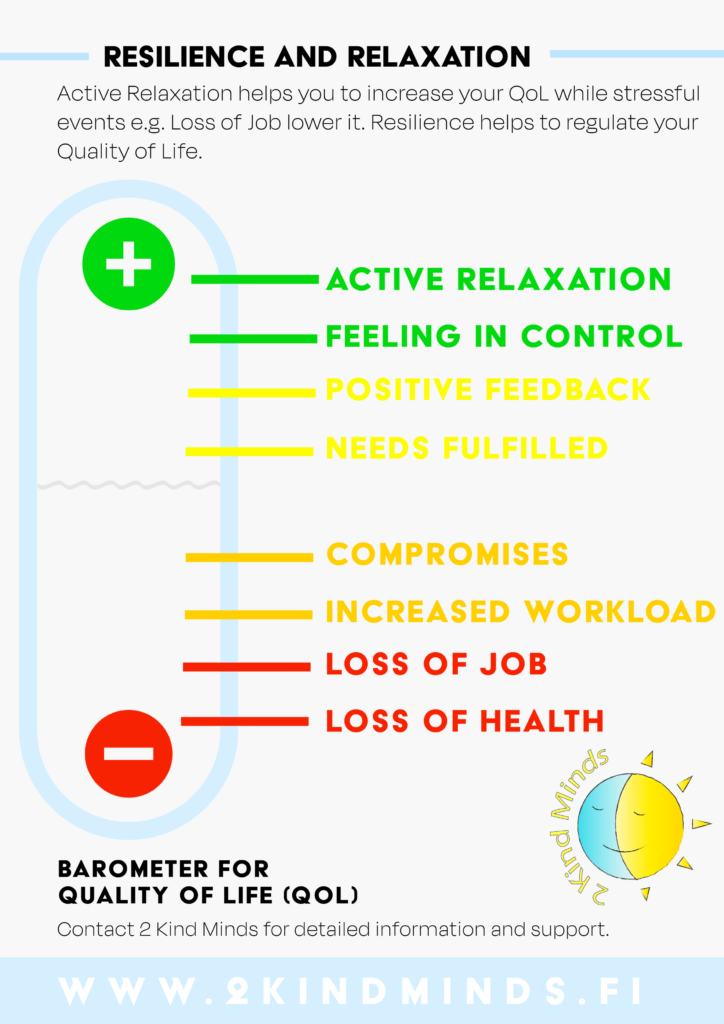
Using the results of the most current studies about the topic and taking control of your own stress will make you more resilient and on top of that, it will increase your self-esteem and stabilize your performance and work.
Taking control
When we have first encountered an extreme situation, we feel empowered after making it through. We will experience the feeling that we have grown through the process. This is the natural way of improving our resilience.
Another way that we can become more resilient is by learning how to take control of our stress levels. Right after a stress reaction, that is caused by changes in the environment, our mind and body tries to return to homeostasis.
When an experience creates so much fear, that the realisation that you made it through is replaced by the fear of recurrence, then this experience will not build resilience and will keep you from returning to homeostasis. This fear will make you feel like you failed and that you might fail again. When we lack a plan on how to tackle a certain situation, we might start to feel helpless, weak, might experience a change in weight or become more forgetful.
We need to understand what sets these two experiences apart. Could it be the severity of the event or the level of stress and the amount of control we believe we had during the event?
The level of experienced stress differs highly from person to person, when they are confronted with the same event. That does not mean you are doomed to fail. It just means that you will need to try again with better preparation.
The first step is always to regain control. One way to achieve that is by understanding the most important limiting factor is our fear (name the beast!). Once we accept that we are afraid, we can take action to overcome this fear.
In the case of intense anxiety we can start by learning a technique that keeps our stress level and the correlating anxiety level down.
Good News: You cannot be afraid and relaxed at the same time!
Relaxation
Actively Controlling Well-being
Physical Relaxation is a cornerstone of Stress Management. The body cannot be relaxed while the mind is stressed and the other way around. During a stressful situation our body will be flooded with hormones, which ensure that we are physically able to flee or fight. This state involves a reduced immune system as well as a reduced ability to plan or think, which is the opposite of what we usually need to be healthy, happy and productive at work.
Regulating the stress level will help us return to our former performance level. How quickly this is possible, highly depends on our resilience – the flexibility to bounce back. This is why active relaxation is so important especially for people who suffer from decreased resilience because of a genetic predisposition or problematic environmental factors.
Active Relaxation techniques such as:
- Breathing exercises,
- Progressive Muscle Relaxation,
- Awareness training
- And individual resources such as sports or other hobbies,
will regulate your stress level more effectively than waiting for it to return to its initial homeostasis naturally. Being able to access tools which help you to stay in control will enable you to think clearly, make better decisions and increase your self-esteem. All this will benefit your flexibility to bounce back from difficult events, which is an increased level of resilience.
Life-long Learning
It is never too late to start something new and there is always room for improvement. Our resilience decreases naturally over time by the limitations posed by continuous age. This may trigger anxiety. Extreme levels of stress have the same effect. Moving your body regularly is always recommended as much as challenging yourself with crossword puzzles or sudoku to keep the mind flexible. The newest addition to this self-care and life-long learning trend is the chance to become more resilient by staying calmer and more relaxed.
Relaxation is a Key Skill for greater Resilience
This is what makes the ability to use effective relaxation strategies to calm yourself down when you are feeling stressed so valuable. By applying effective relaxation techniques that work for you and in that particular moment, you can lower your stress levels and return to the homeostasis that allows creative problem solving.
In our next blog post you will learn about one thoroughly researched and especially effective relaxation technique. In countless clinical and non-clinical settings it has significantly reduced hypertension, fatigue and stress symptoms as well as improved sleeping and lowered anxiety. And guess what, we are not talking about mindfulness meditation. If you are interested in finding out which technique we are talking about you should read next week’s blog post.
Photo by Andrea Caramello on Unsplash
The post How Resilience and Relaxation improve your Quality of Life appeared first on 2 Kind Minds.
]]>The post Use SMART Goals in every Area of your Life appeared first on 2 Kind Minds.
]]>Deprecated: Using null as an array offset is deprecated, use an empty string instead in /var/wp2-finnsokung/wordpress/wp-includes/class-wp-block-type-registry.php on line 168
Deprecated: Using null as an array offset is deprecated, use an empty string instead in /var/wp2-finnsokung/wordpress/wp-includes/class-wp-block-type-registry.php on line 168
Deprecated: Using null as an array offset is deprecated, use an empty string instead in /var/wp2-finnsokung/wordpress/wp-includes/class-wp-block-type-registry.php on line 168
Deprecated: Using null as an array offset is deprecated, use an empty string instead in /var/wp2-finnsokung/wordpress/wp-includes/class-wp-block-type-registry.php on line 168
Deprecated: Using null as an array offset is deprecated, use an empty string instead in /var/wp2-finnsokung/wordpress/wp-includes/class-wp-block.php on line 257
Deprecated: Using null as an array offset is deprecated, use an empty string instead in /var/wp2-finnsokung/wordpress/wp-includes/class-wp-block-type-registry.php on line 168
Deprecated: Using null as an array offset is deprecated, use an empty string instead in /var/wp2-finnsokung/wordpress/wp-includes/class-wp-block-type-registry.php on line 168
Deprecated: Using null as an array offset is deprecated, use an empty string instead in /var/wp2-finnsokung/wordpress/wp-includes/class-wp-block-type-registry.php on line 168
Deprecated: Using null as an array offset is deprecated, use an empty string instead in /var/wp2-finnsokung/wordpress/wp-includes/class-wp-block-type-registry.php on line 168
Deprecated: Using null as an array offset is deprecated, use an empty string instead in /var/wp2-finnsokung/wordpress/wp-includes/class-wp-block-type-registry.php on line 168
Deprecated: Using null as an array offset is deprecated, use an empty string instead in /var/wp2-finnsokung/wordpress/wp-includes/class-wp-block-type-registry.php on line 168
Deprecated: Using null as an array offset is deprecated, use an empty string instead in /var/wp2-finnsokung/wordpress/wp-includes/class-wp-block-type-registry.php on line 168
Deprecated: Using null as an array offset is deprecated, use an empty string instead in /var/wp2-finnsokung/wordpress/wp-includes/class-wp-block-type-registry.php on line 168
Deprecated: Using null as an array offset is deprecated, use an empty string instead in /var/wp2-finnsokung/wordpress/wp-includes/class-wp-block-type-registry.php on line 168
Deprecated: Using null as an array offset is deprecated, use an empty string instead in /var/wp2-finnsokung/wordpress/wp-includes/class-wp-block.php on line 257
Deprecated: Using null as an array offset is deprecated, use an empty string instead in /var/wp2-finnsokung/wordpress/wp-includes/class-wp-block-type-registry.php on line 168
Deprecated: Using null as an array offset is deprecated, use an empty string instead in /var/wp2-finnsokung/wordpress/wp-includes/class-wp-block-type-registry.php on line 168
Deprecated: Using null as an array offset is deprecated, use an empty string instead in /var/wp2-finnsokung/wordpress/wp-includes/class-wp-block-type-registry.php on line 168
Deprecated: Using null as an array offset is deprecated, use an empty string instead in /var/wp2-finnsokung/wordpress/wp-includes/class-wp-block-type-registry.php on line 168
Deprecated: Using null as an array offset is deprecated, use an empty string instead in /var/wp2-finnsokung/wordpress/wp-includes/class-wp-block-type-registry.php on line 168
Deprecated: Using null as an array offset is deprecated, use an empty string instead in /var/wp2-finnsokung/wordpress/wp-includes/class-wp-block-type-registry.php on line 168
Deprecated: Using null as an array offset is deprecated, use an empty string instead in /var/wp2-finnsokung/wordpress/wp-includes/class-wp-block-type-registry.php on line 168
Deprecated: Using null as an array offset is deprecated, use an empty string instead in /var/wp2-finnsokung/wordpress/wp-includes/class-wp-block-type-registry.php on line 168
Deprecated: Using null as an array offset is deprecated, use an empty string instead in /var/wp2-finnsokung/wordpress/wp-includes/class-wp-block-type-registry.php on line 168
Deprecated: Using null as an array offset is deprecated, use an empty string instead in /var/wp2-finnsokung/wordpress/wp-includes/class-wp-block.php on line 257
Deprecated: Using null as an array offset is deprecated, use an empty string instead in /var/wp2-finnsokung/wordpress/wp-includes/class-wp-block-type-registry.php on line 168
Deprecated: Using null as an array offset is deprecated, use an empty string instead in /var/wp2-finnsokung/wordpress/wp-includes/class-wp-block-type-registry.php on line 168
Deprecated: Using null as an array offset is deprecated, use an empty string instead in /var/wp2-finnsokung/wordpress/wp-includes/class-wp-block-type-registry.php on line 168
Deprecated: Using null as an array offset is deprecated, use an empty string instead in /var/wp2-finnsokung/wordpress/wp-includes/class-wp-block-type-registry.php on line 168
Deprecated: Using null as an array offset is deprecated, use an empty string instead in /var/wp2-finnsokung/wordpress/wp-includes/class-wp-block-type-registry.php on line 168
Deprecated: Using null as an array offset is deprecated, use an empty string instead in /var/wp2-finnsokung/wordpress/wp-includes/class-wp-block-type-registry.php on line 168
Deprecated: Using null as an array offset is deprecated, use an empty string instead in /var/wp2-finnsokung/wordpress/wp-includes/class-wp-block-type-registry.php on line 168
Deprecated: Using null as an array offset is deprecated, use an empty string instead in /var/wp2-finnsokung/wordpress/wp-includes/class-wp-block-type-registry.php on line 168
Deprecated: Using null as an array offset is deprecated, use an empty string instead in /var/wp2-finnsokung/wordpress/wp-includes/class-wp-block-type-registry.php on line 168
Deprecated: Using null as an array offset is deprecated, use an empty string instead in /var/wp2-finnsokung/wordpress/wp-includes/class-wp-block.php on line 257
Deprecated: Using null as an array offset is deprecated, use an empty string instead in /var/wp2-finnsokung/wordpress/wp-includes/class-wp-block-type-registry.php on line 168
Deprecated: Using null as an array offset is deprecated, use an empty string instead in /var/wp2-finnsokung/wordpress/wp-includes/class-wp-block-type-registry.php on line 168
Deprecated: Using null as an array offset is deprecated, use an empty string instead in /var/wp2-finnsokung/wordpress/wp-includes/class-wp-block-type-registry.php on line 168
Deprecated: Using null as an array offset is deprecated, use an empty string instead in /var/wp2-finnsokung/wordpress/wp-includes/class-wp-block-type-registry.php on line 168
Deprecated: Using null as an array offset is deprecated, use an empty string instead in /var/wp2-finnsokung/wordpress/wp-includes/class-wp-block-type-registry.php on line 168
Deprecated: Using null as an array offset is deprecated, use an empty string instead in /var/wp2-finnsokung/wordpress/wp-includes/class-wp-block-type-registry.php on line 168
Deprecated: Using null as an array offset is deprecated, use an empty string instead in /var/wp2-finnsokung/wordpress/wp-includes/class-wp-block-type-registry.php on line 168
Deprecated: Using null as an array offset is deprecated, use an empty string instead in /var/wp2-finnsokung/wordpress/wp-includes/class-wp-block-type-registry.php on line 168
Deprecated: Using null as an array offset is deprecated, use an empty string instead in /var/wp2-finnsokung/wordpress/wp-includes/class-wp-block-type-registry.php on line 168
Deprecated: Using null as an array offset is deprecated, use an empty string instead in /var/wp2-finnsokung/wordpress/wp-includes/class-wp-block.php on line 257
Deprecated: Using null as an array offset is deprecated, use an empty string instead in /var/wp2-finnsokung/wordpress/wp-includes/class-wp-block-type-registry.php on line 168
Deprecated: Using null as an array offset is deprecated, use an empty string instead in /var/wp2-finnsokung/wordpress/wp-includes/class-wp-block-type-registry.php on line 168
Deprecated: Using null as an array offset is deprecated, use an empty string instead in /var/wp2-finnsokung/wordpress/wp-includes/class-wp-block-type-registry.php on line 168
Deprecated: Using null as an array offset is deprecated, use an empty string instead in /var/wp2-finnsokung/wordpress/wp-includes/class-wp-block-type-registry.php on line 168
Deprecated: Using null as an array offset is deprecated, use an empty string instead in /var/wp2-finnsokung/wordpress/wp-includes/class-wp-block-type-registry.php on line 168
Deprecated: Using null as an array offset is deprecated, use an empty string instead in /var/wp2-finnsokung/wordpress/wp-includes/class-wp-block-type-registry.php on line 168
Deprecated: Using null as an array offset is deprecated, use an empty string instead in /var/wp2-finnsokung/wordpress/wp-includes/class-wp-block-type-registry.php on line 168
Deprecated: Using null as an array offset is deprecated, use an empty string instead in /var/wp2-finnsokung/wordpress/wp-includes/class-wp-block-type-registry.php on line 168
Deprecated: Using null as an array offset is deprecated, use an empty string instead in /var/wp2-finnsokung/wordpress/wp-includes/class-wp-block-type-registry.php on line 168
Deprecated: Using null as an array offset is deprecated, use an empty string instead in /var/wp2-finnsokung/wordpress/wp-includes/class-wp-block.php on line 257
Deprecated: Using null as an array offset is deprecated, use an empty string instead in /var/wp2-finnsokung/wordpress/wp-includes/class-wp-block-type-registry.php on line 168
Deprecated: Using null as an array offset is deprecated, use an empty string instead in /var/wp2-finnsokung/wordpress/wp-includes/class-wp-block-type-registry.php on line 168
Deprecated: Using null as an array offset is deprecated, use an empty string instead in /var/wp2-finnsokung/wordpress/wp-includes/class-wp-block-type-registry.php on line 168
Deprecated: Using null as an array offset is deprecated, use an empty string instead in /var/wp2-finnsokung/wordpress/wp-includes/class-wp-block-type-registry.php on line 168
Deprecated: Using null as an array offset is deprecated, use an empty string instead in /var/wp2-finnsokung/wordpress/wp-includes/class-wp-block-type-registry.php on line 168
Deprecated: Using null as an array offset is deprecated, use an empty string instead in /var/wp2-finnsokung/wordpress/wp-includes/class-wp-block-type-registry.php on line 168
Deprecated: Using null as an array offset is deprecated, use an empty string instead in /var/wp2-finnsokung/wordpress/wp-includes/class-wp-block-type-registry.php on line 168
Deprecated: Using null as an array offset is deprecated, use an empty string instead in /var/wp2-finnsokung/wordpress/wp-includes/class-wp-block-type-registry.php on line 168
Deprecated: Using null as an array offset is deprecated, use an empty string instead in /var/wp2-finnsokung/wordpress/wp-includes/class-wp-block-type-registry.php on line 168
Deprecated: Using null as an array offset is deprecated, use an empty string instead in /var/wp2-finnsokung/wordpress/wp-includes/class-wp-block.php on line 257
Deprecated: Using null as an array offset is deprecated, use an empty string instead in /var/wp2-finnsokung/wordpress/wp-includes/class-wp-block-type-registry.php on line 168
Deprecated: Using null as an array offset is deprecated, use an empty string instead in /var/wp2-finnsokung/wordpress/wp-includes/class-wp-block-type-registry.php on line 168
Deprecated: Using null as an array offset is deprecated, use an empty string instead in /var/wp2-finnsokung/wordpress/wp-includes/class-wp-block-type-registry.php on line 168
Deprecated: Using null as an array offset is deprecated, use an empty string instead in /var/wp2-finnsokung/wordpress/wp-includes/class-wp-block-type-registry.php on line 168
Deprecated: Using null as an array offset is deprecated, use an empty string instead in /var/wp2-finnsokung/wordpress/wp-includes/class-wp-block-type-registry.php on line 168
Deprecated: Using null as an array offset is deprecated, use an empty string instead in /var/wp2-finnsokung/wordpress/wp-includes/class-wp-block-type-registry.php on line 168
Deprecated: Using null as an array offset is deprecated, use an empty string instead in /var/wp2-finnsokung/wordpress/wp-includes/class-wp-block-type-registry.php on line 168
Deprecated: Using null as an array offset is deprecated, use an empty string instead in /var/wp2-finnsokung/wordpress/wp-includes/class-wp-block-type-registry.php on line 168
Deprecated: Using null as an array offset is deprecated, use an empty string instead in /var/wp2-finnsokung/wordpress/wp-includes/class-wp-block-type-registry.php on line 168
Deprecated: Using null as an array offset is deprecated, use an empty string instead in /var/wp2-finnsokung/wordpress/wp-includes/class-wp-block.php on line 257
Deprecated: Using null as an array offset is deprecated, use an empty string instead in /var/wp2-finnsokung/wordpress/wp-includes/class-wp-block-type-registry.php on line 168
Deprecated: Using null as an array offset is deprecated, use an empty string instead in /var/wp2-finnsokung/wordpress/wp-includes/class-wp-block-type-registry.php on line 168
Deprecated: Using null as an array offset is deprecated, use an empty string instead in /var/wp2-finnsokung/wordpress/wp-includes/class-wp-block-type-registry.php on line 168
Deprecated: Using null as an array offset is deprecated, use an empty string instead in /var/wp2-finnsokung/wordpress/wp-includes/class-wp-block-type-registry.php on line 168
Deprecated: Using null as an array offset is deprecated, use an empty string instead in /var/wp2-finnsokung/wordpress/wp-includes/class-wp-block-type-registry.php on line 168
Deprecated: Using null as an array offset is deprecated, use an empty string instead in /var/wp2-finnsokung/wordpress/wp-includes/class-wp-block-type-registry.php on line 168
Deprecated: Using null as an array offset is deprecated, use an empty string instead in /var/wp2-finnsokung/wordpress/wp-includes/class-wp-block-type-registry.php on line 168
Deprecated: Using null as an array offset is deprecated, use an empty string instead in /var/wp2-finnsokung/wordpress/wp-includes/class-wp-block-type-registry.php on line 168
Deprecated: Using null as an array offset is deprecated, use an empty string instead in /var/wp2-finnsokung/wordpress/wp-includes/class-wp-block-type-registry.php on line 168
Deprecated: Using null as an array offset is deprecated, use an empty string instead in /var/wp2-finnsokung/wordpress/wp-includes/class-wp-block.php on line 257
Deprecated: Using null as an array offset is deprecated, use an empty string instead in /var/wp2-finnsokung/wordpress/wp-includes/class-wp-block-type-registry.php on line 168
Deprecated: Using null as an array offset is deprecated, use an empty string instead in /var/wp2-finnsokung/wordpress/wp-includes/class-wp-block-type-registry.php on line 168
Deprecated: Using null as an array offset is deprecated, use an empty string instead in /var/wp2-finnsokung/wordpress/wp-includes/class-wp-block-type-registry.php on line 168
Deprecated: Using null as an array offset is deprecated, use an empty string instead in /var/wp2-finnsokung/wordpress/wp-includes/class-wp-block-type-registry.php on line 168
Deprecated: Using null as an array offset is deprecated, use an empty string instead in /var/wp2-finnsokung/wordpress/wp-includes/class-wp-block-type-registry.php on line 168
Deprecated: Using null as an array offset is deprecated, use an empty string instead in /var/wp2-finnsokung/wordpress/wp-includes/class-wp-block-type-registry.php on line 168
Deprecated: Using null as an array offset is deprecated, use an empty string instead in /var/wp2-finnsokung/wordpress/wp-includes/class-wp-block-type-registry.php on line 168
Deprecated: Using null as an array offset is deprecated, use an empty string instead in /var/wp2-finnsokung/wordpress/wp-includes/class-wp-block-type-registry.php on line 168
Deprecated: Using null as an array offset is deprecated, use an empty string instead in /var/wp2-finnsokung/wordpress/wp-includes/class-wp-block-type-registry.php on line 168
Deprecated: Using null as an array offset is deprecated, use an empty string instead in /var/wp2-finnsokung/wordpress/wp-includes/class-wp-block.php on line 257
Deprecated: Using null as an array offset is deprecated, use an empty string instead in /var/wp2-finnsokung/wordpress/wp-includes/class-wp-block-type-registry.php on line 168
Deprecated: Using null as an array offset is deprecated, use an empty string instead in /var/wp2-finnsokung/wordpress/wp-includes/class-wp-block-type-registry.php on line 168
Deprecated: Using null as an array offset is deprecated, use an empty string instead in /var/wp2-finnsokung/wordpress/wp-includes/class-wp-block-type-registry.php on line 168
Deprecated: Using null as an array offset is deprecated, use an empty string instead in /var/wp2-finnsokung/wordpress/wp-includes/class-wp-block-type-registry.php on line 168
Deprecated: Using null as an array offset is deprecated, use an empty string instead in /var/wp2-finnsokung/wordpress/wp-includes/class-wp-block-type-registry.php on line 168
Deprecated: Using null as an array offset is deprecated, use an empty string instead in /var/wp2-finnsokung/wordpress/wp-includes/class-wp-block-type-registry.php on line 168
Deprecated: Using null as an array offset is deprecated, use an empty string instead in /var/wp2-finnsokung/wordpress/wp-includes/class-wp-block-type-registry.php on line 168
Deprecated: Using null as an array offset is deprecated, use an empty string instead in /var/wp2-finnsokung/wordpress/wp-includes/class-wp-block-type-registry.php on line 168
Deprecated: Using null as an array offset is deprecated, use an empty string instead in /var/wp2-finnsokung/wordpress/wp-includes/class-wp-block-type-registry.php on line 168
Deprecated: Using null as an array offset is deprecated, use an empty string instead in /var/wp2-finnsokung/wordpress/wp-includes/class-wp-block.php on line 257
Deprecated: Using null as an array offset is deprecated, use an empty string instead in /var/wp2-finnsokung/wordpress/wp-includes/class-wp-block-type-registry.php on line 168
Deprecated: Using null as an array offset is deprecated, use an empty string instead in /var/wp2-finnsokung/wordpress/wp-includes/class-wp-block-type-registry.php on line 168
Deprecated: Using null as an array offset is deprecated, use an empty string instead in /var/wp2-finnsokung/wordpress/wp-includes/class-wp-block-type-registry.php on line 168
Deprecated: Using null as an array offset is deprecated, use an empty string instead in /var/wp2-finnsokung/wordpress/wp-includes/class-wp-block-type-registry.php on line 168
Deprecated: Using null as an array offset is deprecated, use an empty string instead in /var/wp2-finnsokung/wordpress/wp-includes/class-wp-block-type-registry.php on line 168
Deprecated: Using null as an array offset is deprecated, use an empty string instead in /var/wp2-finnsokung/wordpress/wp-includes/class-wp-block-type-registry.php on line 168
Deprecated: Using null as an array offset is deprecated, use an empty string instead in /var/wp2-finnsokung/wordpress/wp-includes/class-wp-block-type-registry.php on line 168
Deprecated: Using null as an array offset is deprecated, use an empty string instead in /var/wp2-finnsokung/wordpress/wp-includes/class-wp-block-type-registry.php on line 168
Deprecated: Using null as an array offset is deprecated, use an empty string instead in /var/wp2-finnsokung/wordpress/wp-includes/class-wp-block-type-registry.php on line 168
Deprecated: Using null as an array offset is deprecated, use an empty string instead in /var/wp2-finnsokung/wordpress/wp-includes/class-wp-block.php on line 257
Deprecated: Using null as an array offset is deprecated, use an empty string instead in /var/wp2-finnsokung/wordpress/wp-includes/class-wp-block-type-registry.php on line 168
Deprecated: Using null as an array offset is deprecated, use an empty string instead in /var/wp2-finnsokung/wordpress/wp-includes/class-wp-block-type-registry.php on line 168
Deprecated: Using null as an array offset is deprecated, use an empty string instead in /var/wp2-finnsokung/wordpress/wp-includes/class-wp-block-type-registry.php on line 168
Deprecated: Using null as an array offset is deprecated, use an empty string instead in /var/wp2-finnsokung/wordpress/wp-includes/class-wp-block-type-registry.php on line 168
Deprecated: Using null as an array offset is deprecated, use an empty string instead in /var/wp2-finnsokung/wordpress/wp-includes/class-wp-block-type-registry.php on line 168
Deprecated: Using null as an array offset is deprecated, use an empty string instead in /var/wp2-finnsokung/wordpress/wp-includes/class-wp-block-type-registry.php on line 168
Deprecated: Using null as an array offset is deprecated, use an empty string instead in /var/wp2-finnsokung/wordpress/wp-includes/class-wp-block-type-registry.php on line 168
Deprecated: Using null as an array offset is deprecated, use an empty string instead in /var/wp2-finnsokung/wordpress/wp-includes/class-wp-block-type-registry.php on line 168
Deprecated: Using null as an array offset is deprecated, use an empty string instead in /var/wp2-finnsokung/wordpress/wp-includes/class-wp-block-type-registry.php on line 168
Deprecated: Using null as an array offset is deprecated, use an empty string instead in /var/wp2-finnsokung/wordpress/wp-includes/class-wp-block.php on line 257
Deprecated: Using null as an array offset is deprecated, use an empty string instead in /var/wp2-finnsokung/wordpress/wp-includes/class-wp-block-type-registry.php on line 168
Deprecated: Using null as an array offset is deprecated, use an empty string instead in /var/wp2-finnsokung/wordpress/wp-includes/class-wp-block-type-registry.php on line 168
Deprecated: Using null as an array offset is deprecated, use an empty string instead in /var/wp2-finnsokung/wordpress/wp-includes/class-wp-block-type-registry.php on line 168
Deprecated: Using null as an array offset is deprecated, use an empty string instead in /var/wp2-finnsokung/wordpress/wp-includes/class-wp-block-type-registry.php on line 168
Deprecated: Using null as an array offset is deprecated, use an empty string instead in /var/wp2-finnsokung/wordpress/wp-includes/class-wp-block-type-registry.php on line 168
Deprecated: Using null as an array offset is deprecated, use an empty string instead in /var/wp2-finnsokung/wordpress/wp-includes/class-wp-block-type-registry.php on line 168
Deprecated: Using null as an array offset is deprecated, use an empty string instead in /var/wp2-finnsokung/wordpress/wp-includes/class-wp-block-type-registry.php on line 168
Deprecated: Using null as an array offset is deprecated, use an empty string instead in /var/wp2-finnsokung/wordpress/wp-includes/class-wp-block-type-registry.php on line 168
Deprecated: Using null as an array offset is deprecated, use an empty string instead in /var/wp2-finnsokung/wordpress/wp-includes/class-wp-block-type-registry.php on line 168
Deprecated: Using null as an array offset is deprecated, use an empty string instead in /var/wp2-finnsokung/wordpress/wp-includes/class-wp-block.php on line 257
Deprecated: Using null as an array offset is deprecated, use an empty string instead in /var/wp2-finnsokung/wordpress/wp-includes/class-wp-block-type-registry.php on line 168
Deprecated: Using null as an array offset is deprecated, use an empty string instead in /var/wp2-finnsokung/wordpress/wp-includes/class-wp-block-type-registry.php on line 168
Deprecated: Using null as an array offset is deprecated, use an empty string instead in /var/wp2-finnsokung/wordpress/wp-includes/class-wp-block-type-registry.php on line 168
Deprecated: Using null as an array offset is deprecated, use an empty string instead in /var/wp2-finnsokung/wordpress/wp-includes/class-wp-block-type-registry.php on line 168
Deprecated: Using null as an array offset is deprecated, use an empty string instead in /var/wp2-finnsokung/wordpress/wp-includes/class-wp-block-type-registry.php on line 168
Deprecated: Using null as an array offset is deprecated, use an empty string instead in /var/wp2-finnsokung/wordpress/wp-includes/class-wp-block-type-registry.php on line 168
Deprecated: Using null as an array offset is deprecated, use an empty string instead in /var/wp2-finnsokung/wordpress/wp-includes/class-wp-block-type-registry.php on line 168
Deprecated: Using null as an array offset is deprecated, use an empty string instead in /var/wp2-finnsokung/wordpress/wp-includes/class-wp-block-type-registry.php on line 168
Deprecated: Using null as an array offset is deprecated, use an empty string instead in /var/wp2-finnsokung/wordpress/wp-includes/class-wp-block-type-registry.php on line 168
Deprecated: Using null as an array offset is deprecated, use an empty string instead in /var/wp2-finnsokung/wordpress/wp-includes/class-wp-block.php on line 257
Deprecated: Using null as an array offset is deprecated, use an empty string instead in /var/wp2-finnsokung/wordpress/wp-includes/class-wp-block-type-registry.php on line 168
Deprecated: Using null as an array offset is deprecated, use an empty string instead in /var/wp2-finnsokung/wordpress/wp-includes/class-wp-block-type-registry.php on line 168
Deprecated: Using null as an array offset is deprecated, use an empty string instead in /var/wp2-finnsokung/wordpress/wp-includes/class-wp-block-type-registry.php on line 168
Deprecated: Using null as an array offset is deprecated, use an empty string instead in /var/wp2-finnsokung/wordpress/wp-includes/class-wp-block-type-registry.php on line 168
Deprecated: Using null as an array offset is deprecated, use an empty string instead in /var/wp2-finnsokung/wordpress/wp-includes/class-wp-block-type-registry.php on line 168
Deprecated: Using null as an array offset is deprecated, use an empty string instead in /var/wp2-finnsokung/wordpress/wp-includes/class-wp-block-type-registry.php on line 168
Deprecated: Using null as an array offset is deprecated, use an empty string instead in /var/wp2-finnsokung/wordpress/wp-includes/class-wp-block-type-registry.php on line 168
Deprecated: Using null as an array offset is deprecated, use an empty string instead in /var/wp2-finnsokung/wordpress/wp-includes/class-wp-block-type-registry.php on line 168
Deprecated: Using null as an array offset is deprecated, use an empty string instead in /var/wp2-finnsokung/wordpress/wp-includes/class-wp-block-type-registry.php on line 168
Deprecated: Using null as an array offset is deprecated, use an empty string instead in /var/wp2-finnsokung/wordpress/wp-includes/class-wp-block.php on line 257
Deprecated: Using null as an array offset is deprecated, use an empty string instead in /var/wp2-finnsokung/wordpress/wp-includes/class-wp-block-type-registry.php on line 168
Deprecated: Using null as an array offset is deprecated, use an empty string instead in /var/wp2-finnsokung/wordpress/wp-includes/class-wp-block-type-registry.php on line 168
Deprecated: Using null as an array offset is deprecated, use an empty string instead in /var/wp2-finnsokung/wordpress/wp-includes/class-wp-block-type-registry.php on line 168
Deprecated: Using null as an array offset is deprecated, use an empty string instead in /var/wp2-finnsokung/wordpress/wp-includes/class-wp-block-type-registry.php on line 168
Deprecated: Using null as an array offset is deprecated, use an empty string instead in /var/wp2-finnsokung/wordpress/wp-includes/class-wp-block-type-registry.php on line 168
Deprecated: Using null as an array offset is deprecated, use an empty string instead in /var/wp2-finnsokung/wordpress/wp-includes/class-wp-block-type-registry.php on line 168
Deprecated: Using null as an array offset is deprecated, use an empty string instead in /var/wp2-finnsokung/wordpress/wp-includes/class-wp-block-type-registry.php on line 168
Deprecated: Using null as an array offset is deprecated, use an empty string instead in /var/wp2-finnsokung/wordpress/wp-includes/class-wp-block-type-registry.php on line 168
Deprecated: Using null as an array offset is deprecated, use an empty string instead in /var/wp2-finnsokung/wordpress/wp-includes/class-wp-block-type-registry.php on line 168
Deprecated: Using null as an array offset is deprecated, use an empty string instead in /var/wp2-finnsokung/wordpress/wp-includes/class-wp-block.php on line 257
Deprecated: Using null as an array offset is deprecated, use an empty string instead in /var/wp2-finnsokung/wordpress/wp-includes/class-wp-block-type-registry.php on line 168
Deprecated: Using null as an array offset is deprecated, use an empty string instead in /var/wp2-finnsokung/wordpress/wp-includes/class-wp-block-type-registry.php on line 168
Deprecated: Using null as an array offset is deprecated, use an empty string instead in /var/wp2-finnsokung/wordpress/wp-includes/class-wp-block-type-registry.php on line 168
Deprecated: Using null as an array offset is deprecated, use an empty string instead in /var/wp2-finnsokung/wordpress/wp-includes/class-wp-block-type-registry.php on line 168
Deprecated: Using null as an array offset is deprecated, use an empty string instead in /var/wp2-finnsokung/wordpress/wp-includes/class-wp-block-type-registry.php on line 168
Deprecated: Using null as an array offset is deprecated, use an empty string instead in /var/wp2-finnsokung/wordpress/wp-includes/class-wp-block-type-registry.php on line 168
Deprecated: Using null as an array offset is deprecated, use an empty string instead in /var/wp2-finnsokung/wordpress/wp-includes/class-wp-block-type-registry.php on line 168
Deprecated: Using null as an array offset is deprecated, use an empty string instead in /var/wp2-finnsokung/wordpress/wp-includes/class-wp-block-type-registry.php on line 168
Deprecated: Using null as an array offset is deprecated, use an empty string instead in /var/wp2-finnsokung/wordpress/wp-includes/class-wp-block-type-registry.php on line 168
Deprecated: Using null as an array offset is deprecated, use an empty string instead in /var/wp2-finnsokung/wordpress/wp-includes/class-wp-block.php on line 257
Deprecated: Using null as an array offset is deprecated, use an empty string instead in /var/wp2-finnsokung/wordpress/wp-includes/class-wp-block-type-registry.php on line 168
Deprecated: Using null as an array offset is deprecated, use an empty string instead in /var/wp2-finnsokung/wordpress/wp-includes/class-wp-block-type-registry.php on line 168
Deprecated: Using null as an array offset is deprecated, use an empty string instead in /var/wp2-finnsokung/wordpress/wp-includes/class-wp-block-type-registry.php on line 168
Deprecated: Using null as an array offset is deprecated, use an empty string instead in /var/wp2-finnsokung/wordpress/wp-includes/class-wp-block-type-registry.php on line 168
Deprecated: Using null as an array offset is deprecated, use an empty string instead in /var/wp2-finnsokung/wordpress/wp-includes/class-wp-block-type-registry.php on line 168
Deprecated: Using null as an array offset is deprecated, use an empty string instead in /var/wp2-finnsokung/wordpress/wp-includes/class-wp-block-type-registry.php on line 168
Deprecated: Using null as an array offset is deprecated, use an empty string instead in /var/wp2-finnsokung/wordpress/wp-includes/class-wp-block-type-registry.php on line 168
Deprecated: Using null as an array offset is deprecated, use an empty string instead in /var/wp2-finnsokung/wordpress/wp-includes/class-wp-block-type-registry.php on line 168
Deprecated: Using null as an array offset is deprecated, use an empty string instead in /var/wp2-finnsokung/wordpress/wp-includes/class-wp-block-type-registry.php on line 168
Deprecated: Using null as an array offset is deprecated, use an empty string instead in /var/wp2-finnsokung/wordpress/wp-includes/class-wp-block.php on line 257
Deprecated: Using null as an array offset is deprecated, use an empty string instead in /var/wp2-finnsokung/wordpress/wp-includes/class-wp-block-type-registry.php on line 168
Deprecated: Using null as an array offset is deprecated, use an empty string instead in /var/wp2-finnsokung/wordpress/wp-includes/class-wp-block-type-registry.php on line 168
Deprecated: Using null as an array offset is deprecated, use an empty string instead in /var/wp2-finnsokung/wordpress/wp-includes/class-wp-block-type-registry.php on line 168
Deprecated: Using null as an array offset is deprecated, use an empty string instead in /var/wp2-finnsokung/wordpress/wp-includes/class-wp-block-type-registry.php on line 168
Deprecated: Using null as an array offset is deprecated, use an empty string instead in /var/wp2-finnsokung/wordpress/wp-includes/class-wp-block-type-registry.php on line 168
Deprecated: Using null as an array offset is deprecated, use an empty string instead in /var/wp2-finnsokung/wordpress/wp-includes/class-wp-block-type-registry.php on line 168
Deprecated: Using null as an array offset is deprecated, use an empty string instead in /var/wp2-finnsokung/wordpress/wp-includes/class-wp-block-type-registry.php on line 168
Deprecated: Using null as an array offset is deprecated, use an empty string instead in /var/wp2-finnsokung/wordpress/wp-includes/class-wp-block-type-registry.php on line 168
Deprecated: Using null as an array offset is deprecated, use an empty string instead in /var/wp2-finnsokung/wordpress/wp-includes/class-wp-block-type-registry.php on line 168
Deprecated: Using null as an array offset is deprecated, use an empty string instead in /var/wp2-finnsokung/wordpress/wp-includes/class-wp-block.php on line 257
Deprecated: Using null as an array offset is deprecated, use an empty string instead in /var/wp2-finnsokung/wordpress/wp-includes/class-wp-block-type-registry.php on line 168
Deprecated: Using null as an array offset is deprecated, use an empty string instead in /var/wp2-finnsokung/wordpress/wp-includes/class-wp-block-type-registry.php on line 168
Deprecated: Using null as an array offset is deprecated, use an empty string instead in /var/wp2-finnsokung/wordpress/wp-includes/class-wp-block-type-registry.php on line 168
Deprecated: Using null as an array offset is deprecated, use an empty string instead in /var/wp2-finnsokung/wordpress/wp-includes/class-wp-block-type-registry.php on line 168
Deprecated: Using null as an array offset is deprecated, use an empty string instead in /var/wp2-finnsokung/wordpress/wp-includes/class-wp-block-type-registry.php on line 168
Deprecated: Using null as an array offset is deprecated, use an empty string instead in /var/wp2-finnsokung/wordpress/wp-includes/class-wp-block-type-registry.php on line 168
Deprecated: Using null as an array offset is deprecated, use an empty string instead in /var/wp2-finnsokung/wordpress/wp-includes/class-wp-block-type-registry.php on line 168
Deprecated: Using null as an array offset is deprecated, use an empty string instead in /var/wp2-finnsokung/wordpress/wp-includes/class-wp-block-type-registry.php on line 168
Deprecated: Using null as an array offset is deprecated, use an empty string instead in /var/wp2-finnsokung/wordpress/wp-includes/class-wp-block-type-registry.php on line 168
Deprecated: Using null as an array offset is deprecated, use an empty string instead in /var/wp2-finnsokung/wordpress/wp-includes/class-wp-block.php on line 257
Deprecated: Using null as an array offset is deprecated, use an empty string instead in /var/wp2-finnsokung/wordpress/wp-includes/class-wp-block-type-registry.php on line 168
Deprecated: Using null as an array offset is deprecated, use an empty string instead in /var/wp2-finnsokung/wordpress/wp-includes/class-wp-block-type-registry.php on line 168
Deprecated: Using null as an array offset is deprecated, use an empty string instead in /var/wp2-finnsokung/wordpress/wp-includes/class-wp-block-type-registry.php on line 168
Deprecated: Using null as an array offset is deprecated, use an empty string instead in /var/wp2-finnsokung/wordpress/wp-includes/class-wp-block-type-registry.php on line 168
Deprecated: Using null as an array offset is deprecated, use an empty string instead in /var/wp2-finnsokung/wordpress/wp-includes/class-wp-block-type-registry.php on line 168
Deprecated: Using null as an array offset is deprecated, use an empty string instead in /var/wp2-finnsokung/wordpress/wp-includes/class-wp-block-type-registry.php on line 168
Deprecated: Using null as an array offset is deprecated, use an empty string instead in /var/wp2-finnsokung/wordpress/wp-includes/class-wp-block-type-registry.php on line 168
Deprecated: Using null as an array offset is deprecated, use an empty string instead in /var/wp2-finnsokung/wordpress/wp-includes/class-wp-block-type-registry.php on line 168
Deprecated: Using null as an array offset is deprecated, use an empty string instead in /var/wp2-finnsokung/wordpress/wp-includes/class-wp-block-type-registry.php on line 168
Deprecated: Using null as an array offset is deprecated, use an empty string instead in /var/wp2-finnsokung/wordpress/wp-includes/class-wp-block.php on line 257
Deprecated: Using null as an array offset is deprecated, use an empty string instead in /var/wp2-finnsokung/wordpress/wp-includes/class-wp-block-type-registry.php on line 168
Deprecated: Using null as an array offset is deprecated, use an empty string instead in /var/wp2-finnsokung/wordpress/wp-includes/class-wp-block-type-registry.php on line 168
Deprecated: Using null as an array offset is deprecated, use an empty string instead in /var/wp2-finnsokung/wordpress/wp-includes/class-wp-block-type-registry.php on line 168
Deprecated: Using null as an array offset is deprecated, use an empty string instead in /var/wp2-finnsokung/wordpress/wp-includes/class-wp-block-type-registry.php on line 168
Deprecated: Using null as an array offset is deprecated, use an empty string instead in /var/wp2-finnsokung/wordpress/wp-includes/class-wp-block-type-registry.php on line 168
Deprecated: Using null as an array offset is deprecated, use an empty string instead in /var/wp2-finnsokung/wordpress/wp-includes/class-wp-block-type-registry.php on line 168
Deprecated: Using null as an array offset is deprecated, use an empty string instead in /var/wp2-finnsokung/wordpress/wp-includes/class-wp-block-type-registry.php on line 168
Deprecated: Using null as an array offset is deprecated, use an empty string instead in /var/wp2-finnsokung/wordpress/wp-includes/class-wp-block-type-registry.php on line 168
Deprecated: Using null as an array offset is deprecated, use an empty string instead in /var/wp2-finnsokung/wordpress/wp-includes/class-wp-block-type-registry.php on line 168
Deprecated: Using null as an array offset is deprecated, use an empty string instead in /var/wp2-finnsokung/wordpress/wp-includes/class-wp-block.php on line 257
Deprecated: Using null as an array offset is deprecated, use an empty string instead in /var/wp2-finnsokung/wordpress/wp-includes/class-wp-block-type-registry.php on line 168
Deprecated: Using null as an array offset is deprecated, use an empty string instead in /var/wp2-finnsokung/wordpress/wp-includes/class-wp-block-type-registry.php on line 168
Deprecated: Using null as an array offset is deprecated, use an empty string instead in /var/wp2-finnsokung/wordpress/wp-includes/class-wp-block-type-registry.php on line 168
Deprecated: Using null as an array offset is deprecated, use an empty string instead in /var/wp2-finnsokung/wordpress/wp-includes/class-wp-block-type-registry.php on line 168
Deprecated: Using null as an array offset is deprecated, use an empty string instead in /var/wp2-finnsokung/wordpress/wp-includes/class-wp-block-type-registry.php on line 168

Let’s look at the concept, using an example:
Imagine that Sarah would like to spend more time on her well-being by practicing relaxation techniques. She has tried to create a habit of spending a few hours per week focusing on her mental well-being before, but the habit never seemed to stick.
This time she is trying to form a SMART goal. She decides that she wants to spend 2 hours per week on a relaxation practice such as progressive muscle relaxation or guided visualization. She knows from experience that she is most stressed and unmotivated on Mondays and Wednesdays, and decides to make time for 1 hour of relaxation exercises on these two days. To find out whether the exercises worked she decides to assess her stress levels on a scale from 1 to 10 before and after each practice. By doing that Sarah has created a SMART goal.
Specific: What exactly is your goal?
You should be able to tell exactly what your goal is. So be specific in formulating it. You know that your goal is specific when you can summarize it in one sentence that includes the outcome, and what techniques you will use to reach the outcome.
Example: “To feel more relaxed, I want to spend 1 hour on Monday and 1 hour on Wednesday by using relaxation exercises”. This goal is specific, because Sarah knows exactly when and how to start her new relaxation routine.
Measurable: How can you tell you are progressing towards your goal?
Being able to put your progress in numbers will help you keep track of how far you are on your path of reaching your goal. We recommend that you find a way to quantify your progress.
Example: The goal is measurable, because she knows when she achieved her goal in two ways: She reaches her goal when she finishes her relaxation exercises on Monday and Wednesday after 60 minutes. She also knows how effective the exercises were, by looking at her self-assessment.
Achievable: Can you reach your goal with the resources available to you?
It is logical that you are only able to reach your goal, if you have everything required to do so. Before you start working towards it, ask yourself: “Do I have everything I need to reach my goal?”. Resources vary greatly from person to person, and can include physical tools, mental and social resources as well as the available time. What you need to achieve your goal depends on what kind of goal you set and on which resources you have available to you.
Example: Sarah’s goal is achievable, because she knows to block out the necessary time on Mondays and Wednesdays and prepares everything she needs beforehand, such as getting the equipment ready and muting her phone to stop it from interrupting her.
Relevant: Is the goal important for the path you have chosen for yourself?
A goal is relevant when we know for certain that it is important for us. Usually we start with setting a goal when we have a problem that we want to solve. If your goal is a solution or a clear step towards finding a solution for a problem you want to solve, your goal is most likely relevant. Make sure you check every now and then and ask yourself whether your goal is still relevant. Our goals and motives change over time, so adjusting them will stop you from wasting unnecessary energy and time.
Example: The goal is very relevant to her, because she wants to improve her mental well-being and knows from experience and research articles she read, that these relaxation exercises help her achieve that.
Time-bound: What time frame will you require to reach your goal?
It is easy to lose track of projects when there is no specific time frame and deadline for finishing them. This is why it is best to have a reasonable plan for how long it will take you to complete the goal. Take into account that tasks will take up the time that they are given, which is explained by Parkinson’s law. It is therefore important that you give yourself enough time to realistically complete the task, but not too much that you are likely to procrastinate on it.
Example: Sarah’s goal is time-bound, because it is reached each week after Wednesday’s practice, and starts again in the following week on Monday. She also knows exactly on which days to practice.
The technique of setting yourself SMART goals can be extremely helpful in reaching bigger, complex goals in all areas of your life. By adding smaller sub-goals you know at any point what your next step should be to get closer to achieving it. Coming up with appropriate sub-goals depends on you and your working style and it is recommended that you adjust your goal when you feel that it has changed, or something is not working for you.
When you first start applying SMART goals you might find it a little difficult, but you will soon get used to the procedure and making sure the goal fits the criteria will become easier over time.
If you would like some help with getting started, you can book a 1-on-1 session with us and we will figure out a way for you to get closer to your goals. Another option is to participate in our 5-week course on building sustainable routines that will help you put new routines into place and set yourself SMART goals to help you on your way.
Photo by Stéphane Fellay on Unsplash
The post Use SMART Goals in every Area of your Life appeared first on 2 Kind Minds.
]]>